
Indian Passport Renewal in the USA: Complete Guide for 2026
27 Mar. 2026
Indian Passport Renewal in the USA: Complete Guide for 2026
If you are an Indian citizen living in the United States and your passport is expiring, expired, full, damaged, lost, or needs updated personal details, the process is usually handled as a passport re-issue, not a simple extension of your current passport.
That distinction is important because it affects the application category, the checklist you follow, and the supporting documents you need to submit.
Many applicants search for “Indian passport renewal in USA,” but the official process generally requires you to apply for Re-issue of Passport through the Government of India’s Passport Seva system and then complete submission through VFS India Consular Application Centres serving your U.S. jurisdiction.
This guide is designed for applicants who want to avoid delays, prevent document mistakes, and understand exactly what applies to their case.
Quick Answer: How to Renew an Indian Passport in the USA
To renew an Indian passport in the USA in 2026, most applicants need to follow this process:
- Complete a Re-issue of Passport application through Passport Seva.
- Select the correct Indian embassy or consulate jurisdiction based on your U.S. residence.
- Upload the required photograph and signature in the correct format.
- Create and complete your application through the VFS Indian Consular portal.
- Pay the required fees and print the final checklist.
- Mail the physical application package with your current passport, supporting documents, and required declarations.
- Track the application through VFS and Passport Seva until dispatch.
For straightforward adult cases, the process is manageable.
Most delays begin when applicants assume every case follows the same document logic.
Which Indian Passport Renewal Cases Are Usually Straightforward
| Situation | Typical Path |
| Passport expiring soon, no major changes | Routine re-issue |
| Expired passport, no personal detail changes | Standard re-issue |
| Passport full with no other changes | Routine re-issue |
| Clear U.S. address proof and legal status documents | Lower-friction case |
Which Indian Passport Renewal Cases Need Extra Caution
| Situation | Why It Needs More Attention |
| Name change | Requires additional supporting documents |
| Spouse name addition or update | Needs supporting records and consistency across documents |
| Lost or damaged passport | Usually involves added scrutiny and extra paperwork |
| Short-validity passport | May require closer review |
| Address change | Can affect jurisdiction and supporting proof requirements |
| Unclear immigration status documents | Can slow review |
| Tatkal request for a restricted or complex case | May not be appropriate for the case |
Renewal vs Re-Issue: What You Are Actually Applying For
This is the first point many applicants get wrong.
Indian passports are generally not renewed by extending the validity of the existing booklet. Instead, applicants usually receive a new passport booklet under the category called Re-issue of Passport.
In practical terms, this means you will usually apply under re-issue if:
- your passport is expiring soon
- your passport has already expired
- your passport has run out of pages
- your passport is damaged or lost
- you need to update personal details such as name, address, spouse name, appearance, or signature
So while “passport renewal” is the phrase most people use in search and conversation, the official application path is usually re-issue.
That is not just a wording difference. It affects the form you choose, the checklist you follow, and the supporting documents you submit.
Who This Indian Passport Renewal Guide Covers
This guide is for Indian citizens living in the United States who need to:
- renew or re-issue an expiring passport
- replace an expired passport
- replace a damaged or lost passport
- update name, address, spouse details, appearance, or signature
- decide between normal processing and Tatkal
- understand which document set applies to their specific situation
If your goal is to renew your Indian passport in the USA without avoidable mistakes, the safest approach is to treat this as a checklist-driven consular application, not as a casual online form.
When to Apply for Indian Passport Renewal in the USA
Do not wait until the last minute.
Many Indian citizens in the United States begin the process well before passport expiry because an expiring passport can create problems for travel planning, visa stamping, immigration filings, and identity verification.
You should strongly consider starting the process when:
- your passport is within 12 months of expiry
- it has already expired
- it has no usable blank pages left
- it is damaged
- it is lost
- you need to update personal information printed on the passport
The earlier you start, the more room you have to handle checklist issues, police verification, or consular follow-up without disrupting travel or immigration timelines.
How to Renew an Indian Passport in the USA: Step-by-Step Process
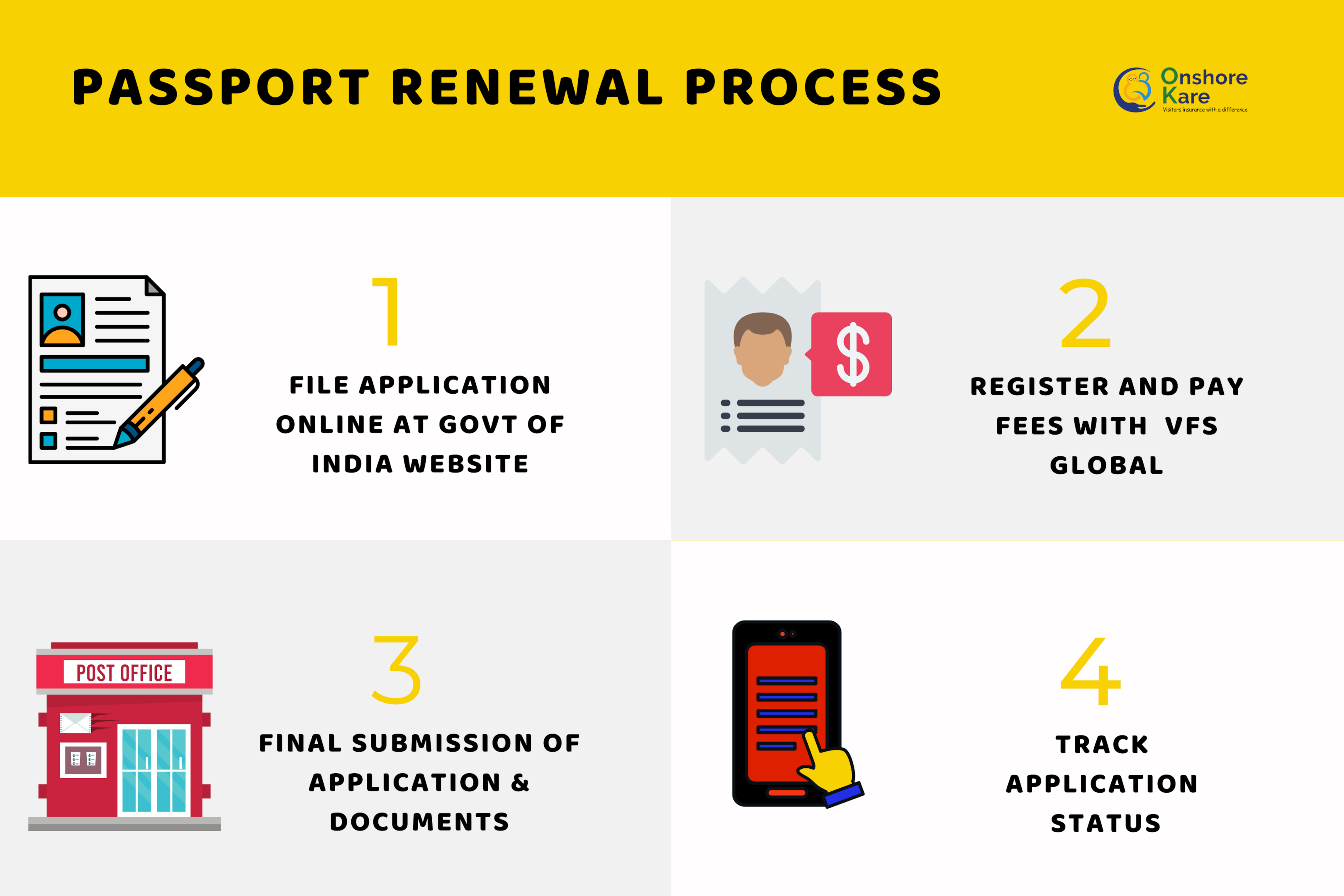
Renewing an Indian passport in the United States is not a one-step online task. It is a multi-stage consular process that begins on the Passport Seva portal and is completed through VFS India Consular Application Centres serving your jurisdiction.
The safest way to approach it is as a checklist-driven application process, not as a simple form submission.
How the Indian Passport Renewal Process Works in the USA
| Stage | Platform or Action | What Happens |
| Step 1 | Passport Seva | Complete the Re-issue of Passport application |
| Step 2 | Passport Seva | Generate the ARN and upload photo and signature |
| Step 3 | VFS | Create the VFS application, select services, and pay fees |
| Step 4 | Physical packet | Print forms, assemble documents, and prepare the package |
| Step 5 | VFS + Consulate | Submit the packet, complete review, and wait for processing |
| Step 6 | Return and delivery | Receive the new passport and verify all details |
This two-system process is where many applicants get confused. Passport Seva starts the application, but VFS handles intake, logistics, and submission for applicants in the United States.
Step 1: Confirm Your Indian Passport Re-Issue Category and Consular Jurisdiction
Before filling out the application, confirm that your case belongs under the correct passport category.
For most applicants, what is commonly called “passport renewal” is actually a passport re-issue. This usually applies if your passport is expiring, expired, full, damaged, lost, or needs updated personal details.
You also need to select the correct Indian embassy or consulate jurisdiction based on your current U.S. residential address.
This matters because the wrong category or wrong jurisdiction can delay, redirect, or complicate the application.
What to confirm before you start
- your case belongs under Re-issue of Passport
- the Indian mission serving your U.S. address is the correct one
- your current address proof matches the jurisdiction you select
Step 2: Complete the Passport Seva Application for Indian Passport Renewal
Once you have confirmed your case type and jurisdiction, complete the application through the Passport Seva system.
You will typically need to enter:
- current passport details
- full name, date of birth, and place of birth
- current U.S. residential address
- Indian address details
- family and emergency contact information
- the reason for passport re-issue
When the application is completed successfully, the system generates an Application Reference Number (ARN). The ARN is important because it connects the government-side application to the VFS submission stage.
What to check before moving to VFS
| Checkpoint | Why It Matters |
| Name matches the passport and supporting documents | Even small mismatches can trigger extra review |
| Date of birth and place of birth are exact | These are high-sensitivity identity fields |
| U.S. and Indian addresses are entered correctly | Address errors often create follow-up issues |
| Reason for re-issue is accurate | The required checklist depends on it |
Step 3: Upload Your Passport Photo and Signature Correctly
This is one of the easiest places to make an avoidable mistake.
Many applicants assume any passport-style photo will work. That assumption creates delays.
Your photograph and signature must meet the required specifications and must be uploaded correctly during the application process. If the files are blurry, incorrectly sized, poorly cropped, or not in the correct format, the application can slow down before substantive review even begins.
Common photo and signature upload mistakes
| Common Mistake | Why It Causes Problems |
| Low-resolution photo | Image may not meet technical standards |
| Incorrect background | Photo may not comply with requirements |
| Face not centered properly | Can lead to rejection or rework |
| Unclear signature image | Signature may not be accepted |
| Wrong file format | Upload may fail or be unusable |
| Using a casual scanned signature | Often creates poor-quality submission files |
Step 4: Create Your VFS Application and Pay the Fees
After completing the Passport Seva portion, move to the VFS Indian Consular portal to continue the process.
At this stage, applicants usually:
- create or log into a VFS account
- enter the ARN
- confirm personal details
- choose the passport booklet type
- select the processing mode, such as normal or Tatkal if eligible
- choose courier and return options
- pay the applicable fees
This is where the application becomes operational. Passport Seva starts the case, but VFS handles the submission workflow for U.S.-based applicants.
What you confirm during the VFS stage
| Item | What You Choose or Confirm |
| ARN linkage | Connects your Passport Seva record to VFS |
| Passport booklet type | Usually 36-page or 60-page booklet |
| Service type | Normal or Tatkal, if eligible |
| Courier options | Sending and return logistics |
| Payment | Government fee, VFS fee, and related charges |
Do not choose Tatkal simply because you are in a hurry. Eligibility matters more than urgency.
Step 5: Prepare Your Indian Passport Renewal Document Packet
This is the part many applicants underestimate.
Even though the process starts online, the application still depends heavily on the physical document packet. That packet must be complete, signed, organized, and matched to the checklist generated for your case.
A typical packet may include:
- printed passport application form
- signed checklist
- current original passport
- self-attested copies of passport pages
- proof of valid U.S. immigration status
- proof of U.S. residential address
- photographs, if required in the packet
- affidavits or declarations
- case-specific supporting documents
The real issue is not whether you “have documents.” The real issue is whether you have the right documents, in the right version, signed where required, and matched to the right case type.
Indian passport renewal packet checklist
| Include in Packet | Notes |
| Printed application form | Must match the submitted online application |
| Current passport | Usually included with the packet |
| Passport copies | Include required pages only |
| U.S. legal status proof | Must clearly support current lawful presence |
| U.S. address proof | Should match the jurisdiction used |
| Affidavits and declarations | Required in many cases |
| Case-specific supporting documents | Depends on name, address, spouse, loss, damage, or other changes |
Step 6: Submit Your Passport Renewal Packet to the Correct VFS Center
Once the packet is ready, it must be sent to the VFS Indian Consular Application Centre serving your jurisdiction.
This step is simple only if the packet is complete and the destination is correct.
Common submission mistakes that delay Indian passport renewal
- sending the packet to the wrong location
- forgetting required signatures
- mailing an incomplete packet
- missing the correct checklist or payment confirmation
- assuming uploaded documents are enough without a complete physical file
The packet should be review-ready the moment it is opened.
Step 7: What Happens After You Submit Your Indian Passport Renewal Application
After the packet reaches VFS, the file is reviewed for completeness before being forwarded to the relevant Indian embassy or consulate.
At this stage, the case may move through several layers:
- intake review
- completeness check
- forwarding to the consulate
- consular assessment
- police verification or additional review in some cases
- printing and dispatch after approval
Straightforward re-issue cases usually move faster than cases involving personal detail changes, lost or damaged passports, or added verification requirements.
What can happen during passport application review
| Scenario | Possible Result |
| Packet is complete and internally consistent | Application moves forward normally |
| Documents are missing or unclear | File may be put on hold or queried |
| Wrong jurisdiction or wrong case type | Delay, correction, or redirection |
| Additional verification is required | Processing time increases |
| Tatkal is not suitable for the case | Urgent handling may not proceed |
Step 8: Receive Your New Passport and Check It Immediately
If the application is approved, a new passport booklet is issued and dispatched through the selected return method.
In many cases, the old passport is also returned, especially if it contains valid visas or travel history you may still need.
As soon as the new passport arrives, review it carefully and check:
- name spelling
- passport number
- date of birth
- place of birth
- spouse name, if updated
- address-related details, where relevant
- passport booklet type
If there is an error, it is better to catch it immediately than during travel, immigration filing, or visa processing.
What Applicants Who Get Through This Process Smoothly Usually Do Right
Applicants who usually move through this process with fewer delays tend to do three things well:
- They select the correct case type from the beginning.
- They prepare the packet carefully instead of rushing it.
- They verify every detail before submission.
That is usually the difference between a smooth application and a preventable delay.
What Documents Are Required for Indian Passport Renewal in the USA
Submitting the correct documents is one of the most important parts of the Indian passport renewal process in the USA.
Most delays do not happen because the form is difficult. They happen because the document packet is incomplete, inconsistent, unsigned, or does not match the reason selected for passport re-issue.
The safest way to prepare your application is to divide documents into two groups:
- Core documents that most adult applicants need
- Additional documents required only in specific situations
This is the simplest way to reduce mistakes and avoid missing case-specific requirements.
Core Documents Required for Most Adult Indian Passport Renewal Applications
Most adult applicants renewing or re-issuing an Indian passport in the USA should expect to submit the following base documents.
| Document | Why It Is Needed | Practical Note |
| Printed passport application form | Forms the official application record | Must match the details submitted online |
| Signed VFS checklist | Confirms the submission package contents | Do not leave required fields or signatures blank |
| Current original Indian passport | Used for identity and prior passport verification | Usually returned after processing |
| Copies of relevant passport pages | Supports passport record review | Typically includes key identification and address pages |
| Recent compliant photograph | Required for passport issuance | Must meet current photo specifications |
| Proof of current U.S. residential address | Confirms jurisdiction and mailing address | Should match the consular jurisdiction selected |
| Proof of valid legal status in the United States | Confirms lawful presence | Immigration documents must be current and legible |
| Required declarations or affidavits | Supports identity and application accuracy | Some forms are mandatory even in straightforward cases |
| Payment confirmation and shipping-related documents | Completes the intake package | Keep copies for your records |
Final Core Document Checklist Before You Submit
Use this table as a final scan before you seal the packet.
| Checkpoint | Yes / No |
| Passport Seva application completed correctly | |
| VFS process completed and checklist printed | |
| Current passport included | |
| Required passport copies included | |
| Photo meets required standards | |
| U.S. address proof included | |
| U.S. immigration status proof included | |
| Required declarations signed | |
| All copies self-attested where required | |
| Packet matches the exact case type selected |
What Counts as Proof of U.S. Address for Indian Passport Renewal
Applicants usually need a document that clearly shows their current residential address in the United States.
Common examples may include:
- state driver’s license
- state ID
- utility bill
- lease agreement
- bank statement
- other accepted residence proof listed in the applicable checklist
The real issue is not just whether you have an address proof. It is whether the document clearly supports the jurisdiction where you are applying.
If your address proof and consular jurisdiction do not align, the application can slow down quickly.
What Counts as Proof of Legal Status for Indian Passport Renewal in the USA
Applicants must usually provide proof that they are legally present in the United States.
Depending on the case, this may include documents such as:
- valid visa page
- I-797 approval notice
- I-94 record
- Green Card
- EAD or other immigration-related approval documents, where applicable
This is one of the most important review areas in the packet. A vague, expired, incomplete, or unclear status document can create avoidable problems.
How to Prepare Indian Passport Renewal Documents Correctly
Even if you have the right documents, your packet can still create problems if it is poorly prepared.
Before submission, make sure:
- all copies are clear and legible
- names and passport details match across documents
- self-attestation is completed where required
- signatures are consistent
- no required affidavit is missing
- the packet follows the checklist for your exact case
A strong packet is not just complete. It is internally consistent.
What Additional Documents Are Required for Specific Indian Passport Renewal Cases
The base documents above are not always enough.
If your passport re-issue involves a change, correction, or complication, you may need extra supporting documents. This is where many applicants make avoidable mistakes.
Additional Documents Required by Indian Passport Renewal Case Type
| Situation | Additional Documents Commonly Needed |
| Passport is expired | Usually the expired passport plus standard supporting documents |
| Name change | Marriage certificate, affidavit, or other name-change proof depending on the reason |
| Spouse name addition or change | Marriage-related supporting documents and related declarations |
| Address change | Additional address proof and supporting records if required |
| Appearance change or signature change | Supporting declaration or affidavit explaining the update |
| Lost passport | Police report, loss declaration, and extra identity-supporting documents |
| Damaged passport | Damaged passport plus explanation and supporting declarations |
| Short-validity passport | Additional immigration or status-related proof may be required |
| Minor passport re-issue | Parent documents, consent-related forms, and minor-specific checklist items |
The standard document list is not enough when the case includes a special change or an irregular situation.
What Documents Are Needed If Your Indian Passport Has Expired
An expired passport does not automatically make the process complicated, but it does mean the application must be handled carefully as a re-issue case.
In many straightforward situations, applicants still submit the standard adult document set along with the expired passport.
What matters most is that:
- the expired passport is included
- your current legal status in the U.S. is clearly documented
- all supporting identity details remain consistent
What Documents Are Needed for an Indian Passport Name Change
Name changes are not standard renewals. They require additional proof.
This often applies in cases involving:
- marriage
- divorce
- remarriage
- formal change in name usage
In these situations, the applicant may need:
- marriage certificate or equivalent legal proof
- affidavit or declaration supporting the name change
- supporting identity documents showing the updated name, where applicable
If the name on the application, passport, immigration record, and supporting documents does not align properly, delays are likely.
What Documents Are Needed to Add or Update a Spouse Name on an Indian Passport
Spouse name updates sound simple but often create confusion.
Applicants should expect this to require:
- marriage-related supporting documents
- declarations matching the requested change
- consistency across passport, marriage, and identity records
Any mismatch in names, spellings, or document sequence can create review issues.
What Documents Are Needed If Your U.S. Address Has Changed
If your current residential address is different from the one associated with prior records, additional address proof may be needed.
This is important because address proof affects:
- consular jurisdiction
- return logistics
- overall application consistency
If your packet shows one address, your application shows another, and your ID shows a third, you are creating a preventable problem.
What Documents Are Needed If Your Indian Passport Is Lost
A lost passport case is more document-sensitive than a standard re-issue.
Applicants should usually expect to provide:
- a police report or loss report
- a signed declaration or affidavit
- identity-supporting documents that help establish the lost passport record
- any other case-specific documentation required by the checklist
Lost passport cases often involve more scrutiny, so the packet needs to be especially disciplined.
What Documents Are Needed If Your Indian Passport Is Damaged
A damaged passport must usually be submitted along with the application, unless the document is completely unavailable.
In these cases, applicants may need:
- the damaged passport
- a written explanation or declaration
- standard identity and status documents
- any additional paperwork triggered by the degree of damage
Damage that affects the photo, passport number, or data pages can make the case more sensitive.
What Documents Are Needed for a Short-Validity Indian Passport Re-Issue
Applicants with a short-validity passport should not assume their case will be treated as routine.
This type of case may require extra review, especially if the original short-validity issue related to immigration status, incomplete documentation, or unresolved verification.
In these situations, supporting U.S. status documents become even more important.
What Documents Are Needed for a Minor’s Indian Passport Re-Issue in the USA
Minor passport applications should not be mixed into the same document logic as adult re-issue cases.
Minor cases typically involve:
- the child’s current passport
- parent passport copies
- proof of the child’s status in the USA
- proof of address
- parental consent-related forms
- additional signatures and declarations
If you want maximum clarity, minor cases should eventually sit in a separate sub-section or separate article.
How to Think About Indian Passport Renewal Documents the Right Way
The wrong mindset is:
“I have most of the documents, so I should be fine.”
The right mindset is:
“My packet must prove identity, nationality, current U.S. residence, current U.S. legal status, and the exact reason for re-issue without contradictions.”
That is the standard.
Which Document Mistakes Commonly Delay Indian Passport Renewal in the USA
| Mistake | Why It Causes Problems |
| Missing signatures | Makes the application incomplete |
| Unclear photocopies | Slows verification |
| Wrong or weak address proof | Creates jurisdiction issues |
| Immigration document does not clearly support current status | Triggers extra scrutiny |
| Name mismatch across documents | Creates identity consistency problems |
| Missing affidavit or declaration | Makes the packet incomplete for that case type |
| Assuming standard documents are enough for a special case | Leads to hold requests or delays |
What to Check Before Moving to the Next Section
Before submission, ask yourself these five questions:
- Does my packet include every core document?
- Does my case require any extra documents beyond the standard list?
- Do all names, addresses, and passport details match across the packet?
- Have I signed, self-attested, and organized everything correctly?
- Does the packet clearly support the exact reason I selected for passport re-issue?
If the answer to any of these is no, the packet is not ready.
Should You Choose Tatkal or Normal Processing for Indian Passport Renewal in the USA
Many applicants assume Tatkal is simply the faster version of Indian passport renewal.
That is not the right way to think about it.
Tatkal is not a universal fast-track option. It is an urgent passport service with eligibility limits. Whether you can use it depends on your case type, the condition of your current passport, and the type of change you are requesting.
If your case is straightforward, Tatkal may be available. If your case involves certain corrections, major changes, or document complications, normal processing is usually the safer and more realistic route.
Quick Comparison of Tatkal vs Normal Processing for Indian Passport Renewal
| Factor | Normal Processing | Tatkal Processing |
| Best for | Most routine re-issue cases | Urgent eligible re-issue cases |
| Eligibility | Broad | Restricted |
| Speed | Standard processing timeline | Faster only if the case qualifies and the packet is complete |
| Risk of delay | Moderate if the packet is incomplete | Still high if the packet is incomplete or the case is not eligible |
| Good fit for complex cases | Usually yes | Often no |
When Tatkal May Be the Right Choice for Indian Passport Renewal
Tatkal may be worth considxering if all of the following are true:
- your case is a straightforward passport re-issue
- your current passport details do not require restricted changes
- your passport is available and usable
- your U.S. legal status documents are clear and current
- your packet is complete and ready for submission without gaps
Tatkal works best for applicants whose case is simple, well-documented, and clearly eligible.
When Normal Processing Is Usually Better for Indian Passport Renewal
Normal processing is usually the better option if:
- your passport is lost
- your passport is badly damaged
- you need a name change
- you need major corrections to personal details
- you need changes involving birth details or parental details
- you are dealing with a short-validity passport
- your status documents need closer review
- your case is not clearly routine
In these situations, trying to force the case into Tatkal can create false expectations and may waste time.
Which Indian Passport Renewal Cases Are Commonly Not Suitable for Tatkal
| Situation | Why Tatkal May Not Fit |
| Lost or stolen passport | Requires added scrutiny and supporting documentation |
| Passport damaged beyond recognition | Identity verification becomes more sensitive |
| Short-validity passport | Often treated as a higher-review case |
| Change in name | Requires supporting proof and added review |
| Change or correction of date of birth | Sensitive identity field |
| Change or correction of place of birth | Sensitive identity field |
| Change in father’s or mother’s name | Requires deeper record consistency |
| Change in signature or appearance for adults | Not treated as a simple urgent re-issue case |
How to Decide Between Tatkal and Normal Processing
The real question is not:
Do you want the passport faster?
The real question is:
Does your case qualify for urgent handling without creating extra risk?
That is the better decision framework.
A straightforward applicant with a clean record, valid status documents, and no restricted changes may be a good Tatkal candidate.
An applicant with a damaged passport, missing documents, conflicting records, or a detail-change request is usually better served by normal processing and a stronger packet.
Common Tatkal Mistakes That Delay Indian Passport Renewal
| Mistake | Why It Causes Problems |
| Choosing Tatkal only because travel is coming up | Urgency does not create eligibility |
| Assuming every re-issue case can be expedited | Some categories are restricted |
| Submitting an incomplete packet under Tatkal | Faster processing does not rescue weak paperwork |
| Booking travel before passport issuance | Creates avoidable financial and travel risk |
| Treating Tatkal like a guarantee | It is still subject to review and case suitability |
Which Indian Passport Renewal Option Fits Your Case Best
| Your Situation | Better Fit |
| Passport expiring soon, no major changes, documents are clear | Tatkal may be worth considering |
| Passport expired but all details remain the same and documents are complete | Tatkal may be possible in some straightforward cases |
| Lost passport | Normal processing is usually safer |
| Damaged passport | Normal processing is usually safer |
| Name or major personal detail change | Normal processing is usually safer |
| Short-validity passport | Normal processing is usually safer |
| Complex record mismatch or unclear immigration paperwork | Normal processing is usually safer |
What to Ask Before Choosing Tatkal for Indian Passport Renewal
Before selecting Tatkal, ask yourself:
- Is my case genuinely straightforward?
- Am I relying on Tatkal because I planned too late?
- Do my documents fully support urgent handling?
- Am I assuming urgency matters more than eligibility?
- Would a complete normal application be safer than a rushed urgent one?
These questions usually lead to a better decision than urgency alone.
What Applicants Should Remember About Tatkal
Tatkal can be useful, but only in the right case.
If your application is simple, complete, and clearly eligible, Tatkal may help shorten the process.
If your case involves changes, corrections, loss, damage, or document complexity, normal processing is usually the more realistic path.
The biggest mistake applicants make is assuming that urgency changes the rules.
It does not.
Processing Time for Indian Passport Renewal in the USA and What Causes Delays
One of the biggest mistakes applicants make is assuming passport processing follows a fixed schedule.
It does not.
Indian passport renewal or re-issue processing in the USA depends on the type of application, the completeness of the document packet, the need for additional verification, and whether the case is submitted under normal processing or Tatkal.
That is why no serious guide should promise a single guaranteed turnaround time.
The better way to think about processing time is this:
- straightforward, well-prepared cases usually move faster
- cases with missing documents, mismatched details, or extra verification usually move slower
- Tatkal may reduce time only for eligible and well-prepared applications
What Factors Affect Indian Passport Renewal Processing Time in the USA
| Factor | Effect on Processing Time |
| Straightforward re-issue with no major changes | Usually faster |
| Complete and well-organized packet | Reduces avoidable delays |
| Missing signatures or documents | Causes hold requests or review delays |
| Name, address, or personal detail changes | Usually increases review time |
| Lost or damaged passport | Often slows processing |
| Police verification or additional scrutiny | Can extend timelines |
| Tatkal eligibility and clean documentation | May help in suitable cases |
| Wrong jurisdiction or inconsistent address proof | Can cause immediate delays |
What Processing Pattern to Expect for Indian Passport Renewal Cases
Instead of giving readers fake precision, it is better to explain the real pattern.
| Case Type | What Applicants Should Expect |
| Routine re-issue case | Usually the most predictable path |
| Re-issue with personal detail changes | May take longer because of added document review |
| Lost or damaged passport case | Often slower than a standard case |
| Tatkal-eligible routine case | May move faster if fully complete |
| Incomplete or inconsistent application | Can be delayed significantly |
The process is usually not slow because the form is complicated. It slows down when the case creates uncertainty.
Why Some Indian Passport Renewal Applications Move Faster Than Others
Applications tend to move faster when:
- the case type is correctly chosen from the beginning
- the applicant uses the correct consular jurisdiction
- the packet is complete on first submission
- all names, dates, and addresses match
- there is no need for clarification or extra verification
Applications tend to move slower when:
- the checklist is treated casually
- the supporting documents are weak or inconsistent
- the case involves changes or corrections
- the passport is lost or damaged
- the application needs follow-up or rework after submission
In most delayed cases, the file contains avoidable friction somewhere in the application.
What Commonly Delays Indian Passport Renewal in the USA
| Common Delay Trigger | Why It Causes Problems |
| Wrong consular jurisdiction | The application may need correction or redirection |
| Incomplete VFS packet | Intake cannot move smoothly |
| Missing signatures | Makes the submission incomplete |
| Incorrect or weak address proof | Creates jurisdiction and identity issues |
| Unclear immigration status proof | Slows legal-status verification |
| Name mismatch across documents | Creates identity consistency concerns |
| Missing affidavit or declaration | Prevents proper case review |
| Poor photo or signature upload | Creates avoidable technical issues |
| Applying under the wrong case type | Affects checklist accuracy and review flow |
| Assuming Tatkal can fix a weak application | Urgent processing does not cure document problems |
Which Indian Passport Renewal Situations Carry Higher Delay Risk
| Situation | Delay Risk |
| Routine re-issue, no changes, complete packet | Lower |
| Expired passport, documents still consistent | Moderate |
| Address update with clean proof | Moderate |
| Name or spouse detail change | Higher |
| Lost passport | Higher |
| Damaged passport | Higher |
| Short-validity passport | Higher |
| Record mismatch across documents | High |
How to Reduce Delays in Indian Passport Renewal Applications
Applicants cannot control every part of the process, but they can reduce self-created delays.
Do this before submission
- verify the exact re-issue reason
- confirm the correct jurisdiction
- match the application details to the passport and supporting documents
- prepare a clean, signed, checklist-based packet
- include every required declaration and case-specific document
- avoid last-minute filing if travel or immigration deadlines are close
That is how delay risk is reduced.
Not by hoping for speed.
Not by choosing Tatkal blindly.
Not by mailing a packet that is “probably fine.”
How to Set Realistic Expectations for Indian Passport Renewal Processing Time
A good passport guide should not tell readers:
“It takes X days.”
That sounds confident, but it is often misleading.
A better and more expert approach is this:
Your timeline depends on whether your case is routine, whether your packet is complete, and whether your file triggers additional review.
That is more accurate, more useful, and more trustworthy.
When to Start the Indian Passport Renewal Process to Avoid Delays
If your passport is expiring soon, do not wait for urgency to make the decision for you.
Start early if:
- the passport is within the final year of validity
- you expect travel soon
- you may need the passport for immigration, visa, or identity purposes
- your case involves any change, correction, or complication
Late planning turns an ordinary administrative process into a preventable emergency.
What Applicants Should Remember About Indian Passport Renewal Processing Time
Processing time for Indian passport renewal in the USA is not just about government speed.
It is also about application quality.
A clean, well-prepared, routine case usually moves more smoothly.
A weak, rushed, or inconsistent case usually creates its own delay.
How to Track Your Indian Passport Renewal Application in the USA
After you submit your passport renewal or re-issue application, the next question is simple:
How do you know where the application stands?
Most applicants do not want a vague answer like “wait for updates.” They want to know which system to check, which reference number to use, and what different status stages usually mean.
The practical answer is this:
You may need to track your application through both the VFS tracking system and the Passport Seva tracking system, depending on which stage of the process you want to check.
Where to Track Your Indian Passport Renewal Application
| Tracking Method | What It Helps You Check | What You Usually Need |
| VFS tracking | Intake, submission, and VFS-side movement | Applicant reference number and date of birth |
| Passport Seva tracking | Government-side passport processing status | ARN or file number and date of birth |
This matters because the application does not move through only one system. It begins through Passport Seva and is then operationally submitted through VFS in the United States.
What Information You Need to Track Your Passport Application
Before you try to track your application, keep these details accessible:
- Application Reference Number (ARN), file number, or applicant reference number
- date of birth of the applicant
- a copy of your VFS receipt, acknowledgement, or application confirmation
- courier or dispatch details, if already issued
Do not wait until you are already anxious to look for these numbers. Save them on the day you submit the application.
What Stages to Expect When Tracking Your Indian Passport Application
| Stage | What It Usually Means |
| Application submitted to VFS | Your packet has entered the intake process |
| Under review by VFS | The file is being checked for completeness |
| Forwarded to Embassy or Consulate | The case has moved beyond intake and into consular handling |
| Under process | The application is under government-side review |
| Printed, dispatched, or ready for courier return | The passport has moved toward completion and return |
The exact wording may vary, but the overall flow is usually the same: intake, review, forwarding, processing, and dispatch.
What Each Indian Passport Tracking Status Really Means
Applicants often overreact to ordinary status changes and underreact to the ones that actually matter.
Here is the more useful way to read them:
| Status Pattern | What It Usually Suggests |
| Received by VFS | The packet has entered the system |
| Under review or processing | The file is still moving normally unless it remains unchanged for an unusually long time |
| Forwarded to Consulate | Intake review is complete and consular handling has begun |
| Additional documents requested | The file cannot move forward until you respond properly |
| Dispatched | The passport has left processing and is on the way back |
The important point is this: not every quiet period means something is wrong. Some stages are simply less visible than applicants expect.
When to Start Tracking Your Indian Passport Renewal Application
Do not start panic-checking the status every hour after submission.
A better approach is to:
- confirm that VFS has received the packet
- check periodically for movement into review or forwarding
- monitor more closely once the application is nearing completion or dispatch
- respond quickly if any additional documents or clarifications are requested
If the packet was sent by courier, first confirm delivery to the correct VFS center before assuming the application is already in active review.
What to Do If Your Indian Passport Application Status Does Not Change
A status that remains unchanged for a short time does not automatically mean there is a problem.
But if the application appears stuck longer than expected, take a structured approach.
Do this first
- confirm you are checking the correct tracking portal
- verify that you entered the reference number correctly
- make sure you are using the applicant’s correct date of birth
- review your email, including spam folders, for VFS or consular communication
- check whether your case type involves added review, changes, or verification
If none of that explains the delay, move to the appropriate support path through VFS or the relevant Indian mission.
What Commonly Confuses Applicants While Tracking Passport Status
| Mistake | Why It Creates Confusion |
| Checking only one system | The application may be at a different stage in the broader workflow |
| Using the wrong reference number | The portal will not return the correct status |
| Expecting every status to update in real time | Tracking usually reflects stage changes, not every internal action |
| Ignoring emails from VFS | Important document requests may arrive outside the tracking portal |
| Assuming “under process” means something is wrong | It often just means the file is still in active handling |
How to Track Your Passport Application Without Wasting Time
The right mindset is not obsessive checking.
The right mindset is controlled monitoring.
Use this approach:
| Time in Process | What You Should Do |
| Right after submission | Save all reference numbers and confirmations |
| Early stage | Confirm packet receipt and intake |
| Mid-stage | Check for movement to consular processing |
| If delay seems unusual | Review email, documents, and case complexity before escalating |
| Near completion | Watch for dispatch and return tracking details |
What Applicants Should Remember About Passport Tracking
Tracking your Indian passport renewal application in the USA is straightforward if you keep the correct reference numbers and use the right portal for the right stage.
The most common mistake is expecting one tracker to explain everything.
In reality, you may need to monitor both the VFS side and the Passport Seva side to understand where the application actually stands.
Estimated Cost of Indian Passport Renewal in the USA
Indian passport renewal costs in the USA depend on the passport booklet type, whether you apply under normal processing or Tatkal, and whether you add courier or other optional services.
The safest way to think about cost is to separate it into three parts:
- passport fee
- VFS and consular service charges
- optional add-ons such as courier and payment convenience fees
Estimated Cost Table for Indian Passport Renewal in the USA
| Application Type | Passport Booklet | Estimated Base Total* |
| Normal processing | 36 pages | About $96 |
| Normal processing | 60 pages | About $121 |
| Tatkal processing | 36 pages | About $246 |
| Tatkal processing | 60 pages | About $271 |
*Estimated base totals typically include the passport fee, Indian Community Welfare Fund charge, and VFS service fee. They may not include card payment convenience charges, courier charges, or other optional service costs.
What Usually Affects the Final Cost of Indian Passport Renewal
| Cost Factor | What It Means |
| Passport booklet type | A 60-page jumbo booklet costs more than a 36-page booklet |
| Processing type | Tatkal costs significantly more than normal processing |
| Payment method | Card payments may add a convenience fee |
| Courier or shipping services | Return shipping and related logistics may increase the final amount |
| Case type | Lost or damaged passport cases may involve a different fee structure |
What Applicants Should Expect When Budgeting for Passport Renewal
For many adult applicants, the biggest cost difference comes from two choices:
- 36-page vs 60-page booklet
- normal processing vs Tatkal
If your case is straightforward and you do not need urgent processing, normal service is usually the lower-cost option.
If your case qualifies for Tatkal, the total cost can increase substantially, so it helps to know that before you begin the VFS submission process.
Important Note About Passport Renewal Fees
Passport fees, VFS fees, courier charges, and payment convenience charges can change. Before you submit your application, always verify the final payable amount during the official Passport Seva and VFS process.
Common Mistakes That Delay Indian Passport Renewal in the USA
Most passport delays are not caused by the system alone.
They are usually caused by applicants making avoidable mistakes before the packet is even properly reviewed.
A good guide does not just explain the official process. It also explains how applicants create delays through preventable errors in case selection, documents, signatures, timing, and expectations.
If you want your Indian passport renewal or re-issue to move more smoothly in the USA, avoid the mistakes below.
Most Common Indian Passport Renewal Mistakes at a Glance
| Mistake | Why It Causes Delays | Risk Level |
| Choosing the wrong application category | The checklist and review path may no longer match the case | High |
| Selecting the wrong consular jurisdiction | The application may need correction, redirection, or rework | High |
| Submitting an incomplete packet | Intake cannot move smoothly if required items are missing | High |
| Missing signatures or self-attestation | Makes the packet incomplete or non-compliant | High |
| Using weak or inconsistent address proof | Creates jurisdiction and identity issues | High |
| Uploading a poor photo or signature | Creates avoidable technical or compliance problems | Moderate to High |
| Assuming Tatkal works for every case | Leads to unrealistic planning | High |
| Ignoring case-specific documents | Standard documents are not enough for special situations | High |
| Waiting too long to apply | Turns a manageable process into an avoidable emergency | Moderate to High |
| Not checking status or email properly | Applicants may miss document requests or updates | Moderate |
Why Applicants Choose the Wrong Passport Re-Issue Category
This is one of the most basic and damaging mistakes.
Many applicants think they are simply “renewing” a passport, but the actual process usually falls under Re-issue of Passport. If the wrong category or reason is selected, the supporting documents may no longer match the application.
Why this mistake happens
- applicants use casual language instead of official application logic
- they assume all expiring passports follow the same path
- they do not think carefully about whether the case includes a change, correction, loss, or damage issue
What to do instead
- confirm the exact reason for re-issue before starting
- make sure the checklist matches your actual case
- do not treat every case as a routine renewal
Why the Wrong Consular Jurisdiction Delays Indian Passport Renewal
This mistake sounds minor, but it is not.
Your application must align with the Indian mission that serves your current U.S. residential address. If you choose the wrong jurisdiction, your file may not move cleanly through intake and review.
Why an Incomplete Passport Renewal Packet Causes Delays
A surprisingly large number of applicants assume they can fix things later.
That is a costly assumption.
If the packet is incomplete at submission, the application may be delayed, put on hold, or returned for correction. A rushed packet is one of the fastest ways to slow down a process you were trying to speed up.
Common items applicants forget to include
- required declarations
- proof of current U.S. status
- address proof
- self-attested copies
- supporting documents for changes or special cases
- required signatures
Why Missing Signatures, Dates, or Self-Attestation Creates Problems
Applicants often focus on the major documents and overlook basic compliance details such as signatures, dates, and self-attestation requirements.
Those small details matter because they affect whether the packet is treated as complete and usable.
Small document-preparation mistakes that create bigger delays
| Small Error | Why It Matters |
| Missing signature on a form | Makes the form incomplete |
| Unsigned declaration | Weakens the submission packet |
| Missing self-attestation on copies | May make supporting documents unacceptable |
| Date omitted where required | Creates procedural gaps |
This process is not only about what documents you submit. It is also about whether those documents are properly prepared.
Why Weak or Inconsistent Address Proof Delays Indian Passport Renewal
Address proof is not just a formality.
It helps establish:
- your current residential address
- your consular jurisdiction
- the internal consistency of the application
If the application shows one address, your ID shows another, and your supporting proof shows a third, the file becomes harder to review.
Why Unclear U.S. Immigration Status Documents Cause Review Issues
Your packet must clearly support your current legal status in the United States.
If the status documents are incomplete, unclear, expired, mismatched, or poorly copied, the file becomes harder to process. This is especially important for applicants whose status depends on approval notices, extensions, or related immigration documentation.
Why Tatkal Cannot Rescue a Weak Passport Application
This is a planning mistake disguised as urgency.
Some applicants wait too long, panic, and then assume Tatkal will solve the problem.
It will not.
Tatkal does not convert a messy, incomplete, or ineligible case into a fast approval. In many cases, urgent processing makes weak preparation more dangerous because there is less room to recover from preventable mistakes.
Why Ignoring Case-Specific Documents Delays Passport Re-Issue
A standard adult re-issue packet is not enough for every case.
If your application involves:
- name change
- spouse name addition or update
- address change
- damaged passport
- lost passport
- short-validity passport
- signature or appearance change
- minor passport
then you may need additional supporting documents beyond the core list.
The common mistake is assuming the standard document set is enough for a non-standard case.
Why Waiting Too Long to Apply Creates Avoidable Passport Problems
This is not just a timing issue. It is usually a planning issue.
Applicants often wait until:
- travel is close
- visa stamping is approaching
- immigration filing requires a valid passport
- the passport is already expired and causing stress
That is how a routine process turns into an urgent one.
Better timing decisions for Indian passport renewal
| Bad Approach | Better Approach |
| “I’ll deal with it when it gets close” | “I’ll start while I still have margin for delays” |
| “It should be quick” | “I should prepare for document review and follow-up” |
| “Tatkal will save me” | “A complete application is safer than a rushed one” |
Why Applicants Should Monitor Tracking and Email Carefully
Some applicants submit the packet and then mentally check out.
That creates risk.
Even after submission, you should monitor:
- tracking updates
- email communications
- courier movement
- any document or clarification request
If you ignore email or tracking, you can miss the update that explains why the case has not moved.
Why Treating Passport Renewal Casually Creates Delays
This is the mistake behind many of the others.
People see “passport renewal” and assume it is a simple clerical task. Sometimes the case is straightforward, but it is never something to handle carelessly.
A passport application packet must prove identity, nationality, current residence, current legal status in the USA, and the exact reason for re-issue without contradictions.
That is a higher standard than many applicants realize.
Which Mistakes Are Most Likely to Put Your Passport Application on Hold
| High-Risk Issue | Why It Commonly Triggers Problems |
| Wrong case type | The checklist no longer matches the request |
| Wrong jurisdiction | The file may need rerouting or correction |
| Missing declaration or affidavit | The packet is incomplete |
| Name mismatch across documents | Identity consistency becomes a concern |
| Weak status proof | Legal-presence review becomes harder |
| Missing self-attested copies | Supporting documents may not be accepted properly |
| No case-specific supporting documents | The application does not fully support the requested change |
How to Avoid Indian Passport Renewal Mistakes Before You Submit
Use this final check before mailing the packet.
Pre-submission mistake prevention checklist
| Question | Yes / No |
| Did I choose the correct re-issue reason? | |
| Does my address proof match the jurisdiction I selected? | |
| Does my packet include every core document? | |
| Did I add all special-case documents for my situation? | |
| Are all copies clear, signed, and self-attested where required? | |
| Do all names, dates, and addresses match across documents? | |
| Have I checked the photo and signature requirements carefully? | |
| Am I choosing Tatkal based on eligibility, not panic? | |
| Have I saved all tracking and submission references? |
If you cannot answer yes to every line above, the packet is not ready.
What Applicants Should Remember About Common Passport Renewal Mistakes
Most delays in Indian passport renewal in the USA are preventable.
They usually happen because applicants rush, assume the standard checklist covers every case, overlook small preparation details, or treat a checklist-driven process like a casual online form.
The better approach is simple: choose the correct case type, prepare a complete packet, match every detail across documents, and start early enough that urgency does not make decisions for you.
Frequently Asked Questions About Indian Passport Renewal in the USA
Can You Renew an Indian Passport in the USA Before It Expires?
Yes. In many cases, applying before expiry is the smarter move.
If your passport is getting close to expiry, starting early gives you more room to handle documentation issues, case-specific requirements, or unexpected delays without creating travel or immigration pressure.
Is Indian Passport Renewal in the USA the Same as Passport Re-Issue?
Usually not.
In most cases, what people call “renewal” is officially handled as Re-issue of Passport. That matters because the application category affects the checklist, supporting documents, and processing path.
How Long Does Indian Passport Renewal Take in the USA?
There is no single timeline that fits every case.
Processing time depends on:
- whether the case is routine or complex
- whether the document packet is complete
- whether the application includes changes or corrections
- whether additional verification is required
- whether the case qualifies for Tatkal
A clean routine case usually moves more smoothly than a file with missing documents, mismatched details, or added review requirements.
Can You Apply for Indian Passport Renewal in the USA Under Tatkal?
Possibly, but only if the case qualifies.
Tatkal is not a universal speed option for every passport application. It is usually more suitable for straightforward eligible cases. If your application involves a lost passport, major corrections, a name change, a short-validity passport, or other sensitive changes, normal processing is often the more realistic route.
What Documents Are Required to Renew an Indian Passport in the USA?
Most adult applicants usually need:
- the completed passport application
- the VFS checklist
- the current passport
- copies of relevant passport pages
- a recent compliant photograph
- proof of current U.S. address
- proof of valid legal status in the USA
- required declarations or affidavits
- additional documents if the case involves a change, correction, damage, or loss
The exact list depends on your case type, which is why a generic document list is never enough for every application.
Can You Renew an Expired Indian Passport in the USA?
Yes, in many cases you can still apply for passport re-issue even if the passport has expired.
What matters is whether the application is complete, the identity details are consistent, and the supporting documents clearly establish the applicant’s current situation in the United States.
Can You Renew a Lost or Damaged Indian Passport in the USA?
Yes, but those cases are more sensitive than a routine re-issue.
A lost or damaged passport case usually requires additional supporting documents, declarations, and closer review. These cases should not be treated like a standard renewal because the document logic is different and the delay risk is usually higher.
Can You Change Your Address While Renewing an Indian Passport in the USA?
Yes, address changes can often be handled as part of the passport re-issue process.
The important issue is consistency. Your application details, address proof, and selected consular jurisdiction should align clearly.
Can You Add or Update a Spouse Name During Indian Passport Renewal in the USA?
Yes, but this is not a minor edit.
Spouse name updates usually require marriage-related supporting documents and related declarations. These cases can slow down if names, spellings, or supporting records do not line up properly.
What Is the Difference Between Normal Processing and Tatkal for Indian Passport Renewal?
Normal processing is the standard route and works for a broad range of cases.
Tatkal is a faster pathway only for eligible cases and is generally more suitable for straightforward applications with clear documentation and no restricted changes.
The better question is not which one is faster. The better question is which one actually fits your case without creating extra risk.
How Do You Track an Indian Passport Renewal Application in the USA?
Applicants usually track their application through the VFS tracking system and, where relevant, the Passport Seva system.
To do that efficiently, keep these details available:
- application reference details
- date of birth
- VFS acknowledgement or confirmation
- courier tracking information, once available
Why Does Indian Passport Renewal Get Delayed in the USA?
Most delays happen for predictable reasons, including:
- wrong application type
- wrong consular jurisdiction
- incomplete packet
- missing signatures
- weak address proof
- unclear immigration documents
- missing affidavits
- name or detail mismatches across documents
- incorrect assumptions about Tatkal eligibility
Many delays are preventable.
Can You Travel While Your Indian Passport Renewal Application Is Being Processed in the USA?
You need to be careful here.
If your current passport has been submitted as part of the application, your ability to travel may be affected until the process is complete and the documents are returned. That is why timing matters.
What Should You Do If Your Indian Passport Renewal Application Is Put on Hold?
First, identify exactly what is missing or unclear.
If the application is put on hold, it usually means something in the packet is incomplete, inconsistent, or not properly supported. Review the reason carefully, gather the exact documents or clarification requested, and respond cleanly and completely.
Can Minors Renew an Indian Passport in the USA Through the Same Process?
Minor passport cases use the same broad system, but not the same document logic as adult applications.
These cases typically involve parent documents, consent-related forms, and minor-specific checklist requirements.
What Is the Biggest Mistake Applicants Make During Indian Passport Renewal in the USA?
The biggest mistake is treating the process as simpler than it is.
That usually leads to other mistakes, including:
- choosing the wrong case type
- assuming the standard document list fits every case
- rushing the packet
- waiting too long
- expecting Tatkal to fix poor planning
Applicants who usually do better are not necessarily smarter. They are just more careful.
Quick FAQ Summary for Indian Passport Renewal in the USA
| Question | Short Answer |
| Can you renew before expiry? | Yes, and starting early is usually wiser |
| Is renewal the same as re-issue? | Usually no; most cases are handled as re-issue |
| Can you use Tatkal? | Only if the case qualifies |
| Can you renew an expired passport? | Yes, in many cases |
| Can you renew a lost or damaged passport? | Yes, but with more documentation and scrutiny |
| Can you update spouse name or address? | Yes, with proper supporting documents |
| How do you track the application? | Through VFS and, where relevant, Passport Seva |
| Why do applications get delayed? | Usually because of preventable document or case-selection errors |
Final Checklist Before You Send Your Indian Passport Renewal Application
Before you seal the envelope or complete final submission, stop and review the application like someone who is trying to catch mistakes, not like someone who is trying to be done.
That mindset matters.
Most avoidable delays happen because applicants reach the final stage and start rushing. They assume the hard part is over, skip a careful review, and send a packet that is incomplete, inconsistent, or poorly organized.
This checklist is designed to help you catch those mistakes before they become delays.
Final Passport Renewal Submission Checklist
| Checkpoint | Yes / No |
| I selected the correct passport re-issue reason | |
| I chose the correct Indian consular jurisdiction based on my U.S. address | |
| My Passport Seva application details match my supporting documents | |
| My VFS checklist is complete and signed | |
| My current passport is included if required for my case | |
| I included copies of all required passport pages | |
| My photo meets the required standards | |
| My signature upload and forms are clear and correct | |
| My U.S. address proof is current and consistent | |
| My proof of legal status in the USA is clear and complete | |
| I included every required affidavit or declaration | |
| I added all case-specific supporting documents for my situation | |
| All copies are clear, legible, and self-attested where required | |
| All names, dates, and addresses match across the packet | |
| I saved my application reference numbers and payment confirmations | |
| I reviewed the packet one last time before submission |
If any of those lines is still uncertain, the packet is not ready.
What to Review One Last Time Before Submission
A final review should focus on the areas that most often create delays.
| Area to Review | What to Check |
| Application type | Make sure the selected re-issue reason actually matches your case |
| Personal details | Check name, date of birth, place of birth, and passport number carefully |
| Address details | Confirm your current address matches your proof and jurisdiction |
| U.S. status documents | Make sure the packet clearly supports your current legal presence |
| Signatures and declarations | Verify nothing is missing, unsigned, or inconsistent |
| Case-specific documents | Confirm you included extra documents for loss, damage, name change, spouse update, or other changes |
Do Not Submit Until These Five Things Are True
This is the shorter version readers can actually use.
Do this before you send the packet
- make sure the case type is correct
- make sure the packet matches the checklist exactly
- make sure every key detail matches across all documents
- make sure all signatures, declarations, and attestations are complete
- make sure you have saved every tracking and submission reference
That is the minimum standard.
Last-Minute Mistakes to Catch Before Mailing the Packet
| Last-Minute Mistake | Why It Is Dangerous |
| Forgetting a signature | Can make the application incomplete |
| Leaving out an affidavit | Can stall review immediately |
| Using inconsistent addresses | Can create jurisdiction confusion |
| Sending weak immigration proof | Can trigger extra scrutiny |
| Forgetting case-specific documents | Can put the application on hold |
| Mailing the packet without a final review | Causes preventable delays that are harder to fix later |
A Better Way to Think About the Final Step
The wrong mindset is:
“I have most of it, so I should just send it.”
The right mindset is:
“This packet must prove my identity, residence, legal status, and reason for re-issue without contradictions.”
That is the actual standard.
Final Submission Readiness Table
| If This Is True | Your Packet Is Probably Ready |
| The case type is correct | Yes |
| The jurisdiction is correct | Yes |
| The core documents are complete | Yes |
| The special-case documents are included | Yes |
| The packet is signed, organized, and internally consistent | Yes |
If even one of those is weak, fix it before submission.
Bottom Line
The final checklist is not a formality.
It is your last chance to catch the mistakes that delay Indian passport renewal in the USA.
Applicants who take this step seriously usually save time.
Applicants who skip it often create problems they could have prevented in ten extra minutes of review.
That is the difference between a smooth submission and an avoidable delay.