

B1/B2 Visa Stay in the USA: Validity, I-94, Extensions and Visitor Insurance
9 Sep. 2026
Getting a B1/B2 visa is only one part of planning a visit to the United States.
A visa may remain valid for several years, but that does not mean you can stay in the United States for that entire period. Each time you travel, U.S. Customs and Border Protection decides whether you will be admitted and how long you may remain on that particular visit.
For parents and relatives planning longer U.S. stays, understanding this difference is especially important. You also need to know where to find your authorized stay date, what happens if you need additional time, and how to prepare for medical expenses during the trip.
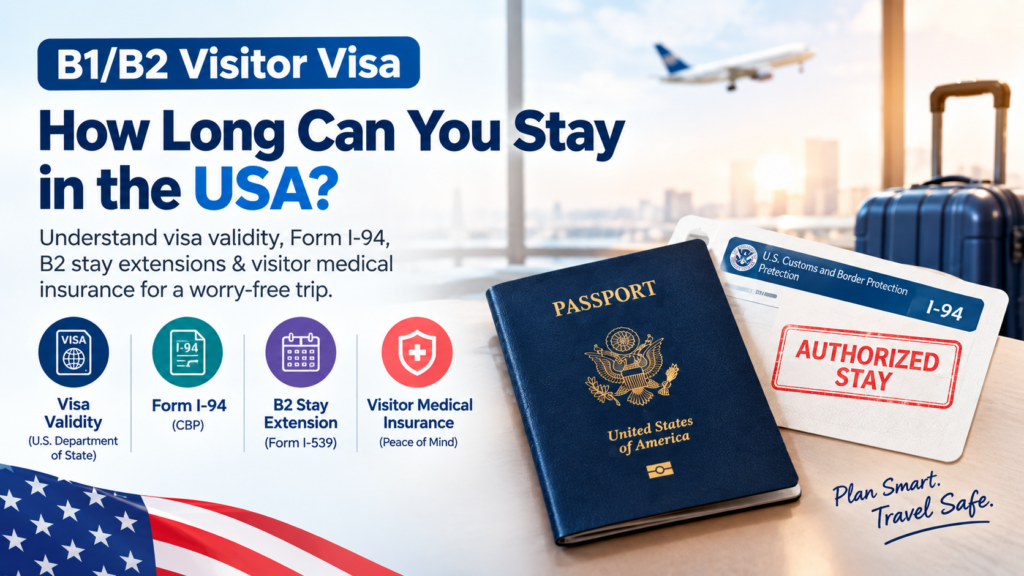
This guide explains B1/B2 visa validity, Form I-94, B2 stay extensions, and visitor medical insurance for travel to the United States.
Quick Answer: How Long Can You Stay in the USA on a B1/B2 Visa?
Your B1/B2 visa expiration date does not determine how long you can stay in the United States.
The visa allows you to travel to a U.S. port of entry and request admission. When you arrive, U.S. Customs and Border Protection determines your authorized period of stay.
After entry, check your Form I-94, particularly the Admit Until Date. This is generally the date that determines when your authorized stay ends.
If you need additional time, eligible B1/B2 visitors may request an extension using Form I-539. The request should generally be filed before the authorized stay expires, and USCIS recommends filing at least 45 days in advance when possible.
Visa Validity and Authorized Stay Are Not the Same Thing
This is one of the most important things for a B1/B2 visitor to understand.
Your visa may remain valid for multiple years and may allow repeated trips to the United States, depending on the visa issued to you. But each time you arrive, CBP makes a new decision about your admission and authorized stay.
| Term | What It Means | Who Determines It |
| Visa validity | The period during which you may use the visa to travel to a U.S. port of entry and request admission | U.S. Department of State |
| Number of entries | How many times the visa may be used to seek admission while valid | Shown on the visa; “M” generally means multiple entries |
| Admission to the USA | Whether you can enter on a particular trip | U.S. Customs and Border Protection |
| Authorized period of stay | How long you may remain during that visit | U.S. Customs and Border Protection |
| Form I-94 | Your admission record showing information such as your class of admission and authorized stay | U.S. Customs and Border Protection |
The expiration date printed on the visa does not tell you how long you can remain after entering the United States.
That is why checking your I-94 after arrival matters.
Is a B1/B2 Visa Valid for 10 Years?
Visa validity depends on the applicant’s nationality and the applicable U.S. visa reciprocity schedule.
For Indian passport holders, B1, B2, and B1/B2 visas may currently be issued as multiple-entry visas valid for up to 120 months, or 10 years.
| Visa Classification | Entries | Validity |
| B1 | Multiple | 120 months |
| B2 | Multiple | 120 months |
| B1/B2 | Multiple | 120 months |
However, a 10-year visa does not mean that you can stay in the United States for 10 years.
It also does not guarantee admission every time you travel or guarantee the same length of stay on every visit.
CBP makes an admission decision each time you arrive.
How Long Can You Stay in the USA on a B1/B2 Visa?
The authorized length of each visit is determined when you enter the United States.
For example:
Visa valid until: June 2036
Authorized stay for this trip: September 15, 2026
In this situation, the traveler generally needs to leave by September 15, 2026, unless they otherwise receive authorization to remain longer. The fact that the visa remains valid until 2036 does not extend the current stay.
Does a B1/B2 Visa Automatically Allow a Six-Month Stay?
No.
You should not assume that every B1/B2 visitor automatically receives six months.
CBP determines the period of stay for each admission. Do not rely on:
- What happened during your previous visit
- How long a friend or relative was allowed to stay
- The expiration date printed on your visa
- An assumption that every B1/B2 visitor receives six months
Check the actual admission record after entering the United States.
What Is Form I-94?
Form I-94 is the arrival and departure record that documents your admission to the United States. For most travelers, this information is maintained electronically.
Your I-94 may include:
- Your name and passport information
- Date of entry
- Class of admission
- Your Admit Until Date
Travelers can retrieve their most recent electronic I-94 through the official CBP I-94 portal.
Why Should You Check Your I-94 After Every Entry?
After arriving in the United States, retrieve your I-94 and make sure the information is correct.
| What to Check | Why It Matters |
| Name and passport information | Helps identify errors in the admission record |
| Class of admission | Should reflect the category under which you entered |
| Admission date | Confirms the recorded date of entry |
| Admit Until Date | Shows your authorized period of stay |
| Travel history | Helps you review recorded U.S. arrivals and departures |
For a B1/B2 visitor, the Admit Until Date is particularly important.
For someone staying several months with family, this should be one of the first things checked after arrival.
What If Your Visa Expires While You Are Already in the United States?
A visa can expire while you are lawfully inside the United States without automatically ending your authorized stay.
For example:
| Date | Example |
| Visa expires | October 1, 2026 |
| I-94 authorized stay ends | December 15, 2026 |
If you were properly admitted through December 15, the visa expiring on October 1 does not by itself shorten that stay.
The reverse is also important.
If your visa remains valid until 2035 but your I-94 says your authorized stay ends on December 15, 2026, you generally need to leave by December 15 unless you have otherwise obtained authorization to stay longer.
A simple way to remember it:
Visa expiration date: How long the visa may generally be used to travel to the United States and request admission.
I-94 Admit Until Date: How long you are authorized to remain during the current visit.
Can You Extend a B2 Stay in the United States?
Eligible B1/B2 visitors may request an extension of their authorized stay by filing Form I-539, Application to Extend/Change Nonimmigrant Status, with U.S. Citizenship and Immigration Services.
An extension is not automatic.
The request should generally be filed before the authorized stay shown on the I-94 expires. USCIS recommends filing at least 45 days before expiration, when possible.
B2 Stay Extension at a Glance
| Question | Answer |
| Can a B2 visitor request additional time? | Yes, eligible visitors may apply for an extension |
| Which form is used? | Form I-539 |
| Which date matters? | The authorized stay or I-94 date, not simply the visa expiration date |
| When should you file? | Before the authorized stay expires, preferably at least 45 days in advance |
| Is approval guaranteed? | No. USCIS reviews each request individually |
| Does filing automatically give you another six months? | No |
| What should the request explain? | Why additional time is needed, why the stay remains temporary, financial support and departure plans |
For example, if your B1/B2 visa is valid until June 2035 but your I-94 expires on November 20, 2026, November 20 is the date relevant to your current stay.
What Information May Be Needed for a B2 Extension?
A B1 or B2 visitor requesting an extension should be prepared to explain:
- Why additional time is needed
- Why the extended stay would still be temporary
- What arrangements have been made to leave the United States
- Whether the longer stay affects employment or residence outside the United States
- How expenses will be covered during the additional stay
- Whether the conditions of B1/B2 status have been maintained
Financial support may include the ability to cover accommodation, food, transportation, medical needs, and other expenses during the requested period.
The explanation should reflect the traveler’s actual circumstances. A B2 extension is not simply a request for “another six months.”
Why Might Someone Request a B2 Extension?
USCIS considers each request individually.
Possible circumstances could include an unexpected change in travel plans, additional time needed with family, a medical situation, an unforeseen personal circumstance, or another legitimate temporary reason.
These examples do not guarantee approval.
The main question is whether the visitor can demonstrate that the additional stay remains temporary and that they can support themselves during that period.
Does USCIS Automatically Give You Another Six Months?
No.
Filing Form I-539 does not automatically give a B2 visitor another six months. USCIS must decide whether to approve the request and the length of any approved extension.
Think of the process as:
Request additional time → explain why → demonstrate that the visit remains temporary → wait for the USCIS decision
When Should You File a B2 Extension?
File before your current authorized stay expires and, when possible, at least 45 days in advance.
| Timeline | What to Do |
| After arriving in the USA | Retrieve and check your I-94 |
| During the visit | Keep track of the Admit Until Date |
| If you realize you need more time | Decide whether an extension request is appropriate |
| Preferably 45+ days before expiration | Prepare Form I-539 and supporting information |
| Before the I-94 expires | File the application |
| After filing | Keep the receipt and monitor the USCIS case |
If you already know that you may need additional time, do not wait until the last day.
What If Your I-94 Has Already Expired?
Late filing can create significant immigration problems.
USCIS may excuse a late extension request only in limited circumstances when applicable requirements are met, such as where the delay resulted from extraordinary circumstances beyond the applicant’s control.
Do not assume that a late application will simply be accepted.
If your authorized stay has already expired or you are uncertain about your immigration status, professional U.S. immigration advice may be appropriate.
Can a B2 Extension Affect Future U.S. Visits?
It can become part of your immigration history.
Requesting a legitimate extension does not automatically cause a future visa or admission problem. However, previous travel patterns and immigration history may be considered during later visa applications or entry decisions.
Visitors should therefore avoid treating extensions as a routine way of effectively living in the United States.
A B1/B2 visa remains intended for temporary visits.
What If You Leave While the Extension Is Pending?
If you leave the United States before USCIS decides the extension application, keep copies of your application and USCIS receipt notice for your records and possible future travel.
Departure can affect the practical purpose of the extension request, so travelers with pending cases should review the current USCIS instructions carefully.
A Note for Parents Making Longer U.S. Visits
Parents visiting children in the United States sometimes stay for several months.
For these travelers, three dates should never be confused:
| Date | Why It Matters |
| Visa expiration date | How long the visa may generally be used to seek admission |
| I-94 Admit Until Date | How long you are authorized to stay during the current visit |
| Planned departure date | Should normally fall within your authorized stay unless another lawful authorization applies |
Check the I-94 shortly after every arrival and plan the return trip around the period actually granted rather than assuming every visit will receive the same length of admission.
Do You Need Visitor Medical Insurance for a B2 Visa?
Visitor medical insurance is not a standard requirement for obtaining a B1/B2 visitor visa.
That does not mean it should be ignored.
A visa determines whether you may travel to a U.S. port of entry and request admission. Visitor medical insurance serves a different purpose: helping manage the financial risk of eligible medical expenses during the trip.
Visa Requirement vs. Travel Protection
| Question | Answer |
| Is visitor insurance required for a B1/B2 visa? | No, it is not a standard visa requirement |
| Do you need it for the visa interview? | Not as a standard requirement |
| When should you consider buying it? | Once the visa is approved and travel dates are reasonably clear |
| Is it the same as domestic U.S. health insurance? | No. Visitor plans have their own benefits, limits, deductibles and exclusions |
| Does every visitor need the same plan? | No. Needs vary by age, trip duration, medical history and coverage preferences |
Why Should Visitors Consider Medical Insurance for the USA?
Unexpected medical needs during a trip may include emergency treatment, hospitalization, diagnostic testing, specialist care, or other eligible medical services.
Medical treatment in the United States can result in substantial out-of-pocket expenses, so visitor insurance is primarily about financial protection during the trip, not satisfying an immigration requirement.
A practical time to compare plans is after the visa is approved and your expected travel dates become clearer.
By then, you are more likely to know:
- Arrival and departure dates
- Length of stay
- Traveler’s age
- Number of travelers needing coverage
- Whether health-history considerations require closer review
If travel plans change, also check whether the policy allows extension or renewal and whether action must be taken before the existing coverage expires.
What Should You Compare When Choosing Visitor Medical Insurance?
There is no single visitor insurance policy that is best for everyone.
| Factor | Why It Matters |
| Traveler’s age | Availability, premium and maximum coverage may vary by age |
| Length of stay | A two-week trip and a six-month visit create different coverage needs |
| Policy maximum | Sets the maximum the plan may pay for eligible expenses, subject to policy terms |
| Deductible | Affects how much you may need to pay before certain benefits begin |
| Medical history | Particularly important for parents and senior visitors |
| Pre-existing-condition provisions | Plans can differ considerably in how these benefits are defined |
| Benefits and exclusions | Exclusions can be as important as advertised benefits |
| Provider access | Can affect where and how eligible care is accessed |
| Emergency coverage | Important when comparing the protection offered by different plans |
| Coverage duration and renewability | Important when a trip may become longer than expected |
Two plans with similar prices can work very differently once you compare these details.
The cheapest plan is therefore not automatically the best option. A lower-cost plan may work for one traveler and create too much out-of-pocket risk for another.
Why Do Pre-Existing Conditions Matter for Parents and Senior Travelers?
Parents and senior relatives may already have conditions such as diabetes, high blood pressure, heart disease, or other ongoing medical concerns.
That does not mean every medical event related to an existing condition will automatically be covered.
Terms such as:
- Pre-existing condition
- Acute onset of a pre-existing condition
- Policy maximum
- Maximum benefit
- Deductible
- Eligible medical expense
- Exclusion
can significantly affect what a policy actually pays.
Travelers should review the policy wording instead of assuming that a plan mentioning pre-existing-condition benefits covers every treatment connected with an existing condition.
For parents and senior visitors, comparing benefits and limitations side by side can be particularly useful.
How OnshoreKare Can Help You Compare Visitor Insurance
Once your B1/B2 visa is approved and your travel dates are confirmed, OnshoreKare helps international travelers compare visitor medical insurance options for travel to the United States.
This may include plans suitable for:
- Parents visiting children in the USA
- Senior travelers
- Short visits
- Longer stays
- Travelers who want to understand how different plans address certain pre-existing-condition-related benefits
The goal is not simply to choose the policy with the lowest price.
Compare coverage based on the traveler’s age, trip duration, deductible preference, medical history, policy maximum, benefits, exclusions, and extension or renewability needs.
Compare visitor medical insurance plans with OnshoreKare before your U.S. trip.
Essential Official U.S. Government Resources
U.S. visa and immigration procedures can change, so use official government resources for current instructions.
| Official Portal / Agency | Website Domain | Purpose |
| CEAC | ceac.state.gov | Complete and submit Form DS-160 and upload the visa photo |
| U.S. Department of State | travel.state.gov | Check visa requirements, current fees, wait times and country-specific reciprocity information |
| U.S. Embassy & Consulates Portal | usembassy.gov | Find local appointment, interview and document-submission instructions |
| U.S. Customs and Border Protection | i94.cbp.dhs.gov | Retrieve the electronic Form I-94 and review the authorized stay after entry |
| U.S. Citizenship and Immigration Services | uscis.gov | Review Form I-539 instructions and information about extending an authorized stay |
Security Note: Always verify that you are using an official U.S. government website before entering passport numbers, personal information, or payment details. Third-party websites claiming to process U.S. visas may charge additional fees.
Starting Your B1/B2 Visa Application?
This article covers what happens once you have your visa and travel to the United States, including your authorized stay, I-94, possible extensions, and visitor medical insurance.
If you are still at the beginning of the process, start with our complete application guide covering B1/B2 eligibility, the DS-160, visa fees, and appointment scheduling.
Start Here: U.S. B1/B2 Visitor Visa 2026: How to Apply, DS-160, Fees and Interview Scheduling →
Frequently Asked Questions
What if I cannot find my I-94 after entering the United States?
Check that your name, date of birth, passport number, and citizenship information match the travel document used for entry. If the record still cannot be retrieved or contains an error, follow the assistance or correction instructions provided by U.S. Customs and Border Protection.
Can I stay in the USA while my B2 extension is being processed?
Filing Form I-539 does not mean that the extension has been approved. A timely filed application can involve specific rules while the case remains pending, so visitors should follow current USCIS instructions carefully and should not assume that filing automatically gives them another six months.
Can overstaying my I-94 affect future travel to the USA?
Yes. Remaining beyond your authorized stay can have immigration consequences and may affect future visa or admission decisions. Always use the I-94 Admit Until Date, rather than the visa expiration date, when tracking your current authorized stay.
Can visitor insurance be extended if my parents stay longer in the USA?
It depends on the policy. Some visitor insurance plans allow extension or renewal, while others have specific duration limits and conditions. If the trip may become longer, check the policy’s extension rules before purchasing and before the existing coverage expires.