

Top 10 Travel Trends to Watch in 2026: What Is Changing and Why It Matters
25 Apr. 2026
Travel in 2026 is not just changing in where people go. It is changing in how they plan, what they prioritize, and how much disruption they can realistically absorb once a trip is booked.
That is the real shift.
Compared with a few years ago, travel decisions now involve earlier research, tighter schedules, stronger demand for personalization, and greater sensitivity to cost. Travelers are using AI to compare options faster, choosing shorter and more purpose-driven trips, looking beyond overcrowded destinations, and paying closer attention to risk before departure.
For international travelers, these changes matter even more. A missed connection, a delayed document, or an unexpected medical issue can affect not just convenience, but the economics of the entire trip.
This is why travel trends in 2026 should not be treated as lightweight lifestyle observations. They are practical signals about how travel behavior is changing and what smarter travelers need to do differently.
In this guide, we break down the biggest travel trends shaping 2026, explain what each one means in practical terms, and show where travelers should pay closer attention before they finalize a trip.
What Are the Biggest Travel Trends Shaping Trips in 2026?
The biggest travel trends in 2026 point in one direction: travel is becoming more intentional, more customized, and less forgiving of poor planning.
Some of the clearest shifts include:
- Travelers are booking with a more specific purpose
- AI is becoming part of trip research and itinerary planning
- Shorter trips are replacing longer, more flexible vacations in many cases
- Experiences are influencing destination choices more than generic sightseeing
- Travelers are focusing more on value than on unnecessary upgrades
- Less crowded and secondary destinations are attracting more interest
- Wellness and recovery are becoming mainstream travel priorities
- Personalized itineraries are replacing one-size-fits-all travel packages
- More travelers are thinking about disruption, delays, and medical risk before departure
Taken together, these changes show that travel planning is becoming more structured and more consequence-heavy. When timing is tighter and costs are higher, mistakes carry more weight.
Quick Answer: What Should Travelers Do Differently in 2026?
If you are planning a trip in 2026, the practical takeaway is simple: treat travel planning as risk-managed decision-making, not just booking logistics.
| What is changing in 2026 | What travelers should do |
| Trips are more purpose-driven | Build around fixed dates and critical commitments first |
| Planning starts earlier | Compare flights, stays, entry requirements, and health coverage sooner |
| AI influences decisions | Use AI for research, but verify important details before booking |
| Trips are getting shorter | Protect high-value days and avoid fragile connections |
| Budgets are tighter | Compare total trip cost, not just headline prices |
| Experiences drive bookings | Reserve timed or limited-access activities early |
| Risk awareness is rising | Review delay, cancellation, and medical exposure before departure |
The travelers who will handle 2026 best are not the most spontaneous. They are the ones who plan with more precision, leave less to chance, and think through what happens if the trip does not go exactly as expected.
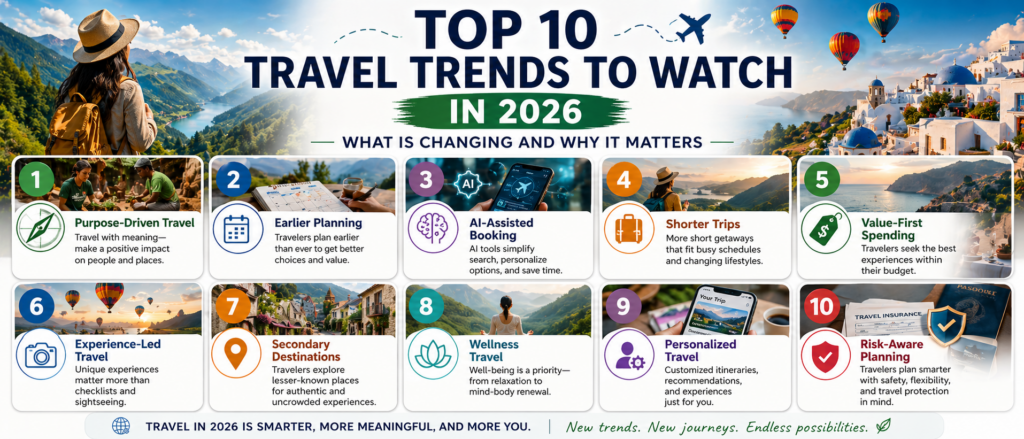
Top 10 Travel Trends to Watch in 2026
Travel trends in 2026 reflect a deeper behavioral shift: people are planning more carefully, personalizing more aggressively, spending more selectively, and showing less tolerance for disruption once a trip is booked.
That matters because the cost of getting travel decisions wrong is higher now than it was a few years ago. When trips are shorter, schedules are tighter, and budgets are watched more closely, flexibility becomes more limited.
The ten trends below are the ones most likely to shape how travelers research, book, and experience trips in 2026.
| Trend | What is changing | Why it matters |
| Purpose-driven travel | Trips are tied to family, events, and milestones | Dates are less flexible |
| Earlier planning | Travelers research more before booking | Bad surprises become more costly |
| AI-assisted booking | Planning is faster and deeper | Verification matters more |
| Shorter trips | Fewer travel days | Each lost day hurts more |
| Value-first spending | Travelers want a clearer return on spend | Better comparison matters |
| Experience-led travel | Events shape destination choice | Timing becomes critical |
| Secondary destinations | Travelers look beyond crowded hotspots | Tradeoffs need more planning |
| Wellness travel | Rest and recovery matter more | Smoother itineraries matter |
| Personalized travel | Trips are built around individual needs | Fewer easy substitutes |
| Risk-aware planning | Travelers think more about what could go wrong | Preparation matters more |
Why Are Purpose-Driven Trips Replacing Flexible Vacations in 2026?
More trips now begin with a clear reason rather than a vague desire to get away. Visiting family, attending weddings, taking milestone trips, and planning around school or work calendars are increasingly shaping when and how people travel.
This changes the structure of the trip. Dates become less negotiable, flight choices narrow, and delays matter more when the trip is tied to a fixed event or family obligation.
Purpose-driven travel also compresses decision-making around what matters most. Travelers become less interested in wandering and more focused on getting the trip right.
Why Are Travelers Booking Earlier and Planning More Intensively?
Travel planning now starts earlier because travelers are trying to reduce uncertainty before they commit. Instead of making quick decisions around flights and hotels, many now compare route quality, baggage rules, visa timing, cancellation terms, local transportation, and healthcare exposure before booking.
That is a rational response to a travel environment with less room for error. Early planning gives travelers more control over cost, timing, and backup options.
This does not mean every trip is booked months in advance. It means the research phase is longer, more detailed, and less casual than before.
How Is AI Changing the Way People Research and Book Travel?
AI is becoming part of the travel planning stack. Travelers are using it to compare destinations, summarize entry requirements, estimate costs, spot itinerary gaps, and generate travel options faster than traditional search alone.
But the important point is not just speed. AI raises expectations. When a trip has been researched in detail with AI assistance, travelers expect smoother execution and may underestimate how often real-world travel still breaks.
That creates a subtle risk. AI can accelerate discovery and comparison, but it does not remove the need to verify visa rules, baggage terms, cancellation windows, provider restrictions, or medical coverage limitations.
In 2026, smart travelers will use AI to improve planning, not to outsource judgment.
Why Are Shorter Trips Becoming More Common in 2026?
For many travelers, shorter trips make more sense than long vacations. Time pressure, cost discipline, family obligations, and event-based travel are all pushing itineraries toward fewer days and tighter schedules.
Shorter trips may look simpler, but they are often less resilient. A missed connection on a ten-day trip is annoying. A missed connection on a four-day trip can damage the entire experience.
The shorter the trip, the higher the value of each travel day. That increases the importance of smart routing, realistic layovers, and stronger contingency planning.
Why Are Travelers Focusing More on Value Than on Luxury Upgrades?
Travelers are not necessarily spending less. They are spending more deliberately.
Instead of automatically paying for upgrades, many are asking whether each extra dollar actually improves the trip in a meaningful way. The question is shifting from “Can I afford this?” to “Is this worth it?”
This affects everything from airfare to room categories to paid experiences. Travelers are still willing to spend for convenience, comfort, or memorable moments, but they want a clearer return on spending.
| Earlier travel mindset | 2026 travel mindset |
| Spend more for upgrades | Spend more only where value is clear |
| Longer trips with more flexibility | Shorter trips with higher day-by-day value |
| Compare headline prices | Compare total trip cost and consequences |
| Assume you can adjust later | Build with less room for error |
How Are Experiences and Events Driving Destination Choice in 2026?
Destinations are increasingly being chosen because of what travelers want to do there, not just because the place itself is famous.
Concerts, sporting events, food experiences, festivals, wellness programs, and milestone activities are becoming stronger trip triggers. In many cases, the experience is chosen first and the destination follows.
This matters because experience-led travel usually comes with fixed timing. If the event is on a certain date, flexibility disappears. That raises the cost of delays, missed arrivals, and poor coordination.
People do not just lose money when an experience-led trip fails. They lose the moment they built the trip around.
Why Are More Travelers Choosing Less Crowded and Secondary Destinations?
A growing number of travelers are looking beyond the most obvious tourist hotspots. Some want quieter experiences. Some want lower costs. Some want to avoid overtourism, congestion, and inflated prices.
Secondary destinations can create a better experience, but they also require more planning. Transportation may be less frequent, healthcare access may be less predictable, and support infrastructure may be thinner than in major gateway cities.
That is the tradeoff weak travel content usually ignores. Less crowded places can be a better choice, but only if travelers plan for the reduced margin of convenience.
Why Are More Travelers Prioritizing Rest, Recovery, and Wellness in 2026?
Wellness travel is no longer a niche category. In 2026, it is increasingly part of mainstream travel planning. Travelers are choosing slower itineraries, sleep-friendly schedules, nature-oriented stays, and trips designed to feel restorative rather than exhausting.
This changes what travelers optimize for. A wellness-oriented trip is not built around maximum activity. It is built around energy, recovery, and personal capacity.
That shift also increases the importance of smooth transit, manageable schedules, and fewer avoidable disruptions.
Why Is Hyper-Personalized Travel Growing Faster Than Standardized Packages?
Travelers increasingly want trips that reflect who they are, not just what the market has packaged for them. Solo itineraries, micro-group travel, accessibility needs, food preferences, age-specific planning, and interest-based routing are all pushing travel away from one-size-fits-all templates.
Personalization creates stronger satisfaction when it works. It also creates fewer substitutes when it does not.
The more customized the trip, the harder it may be to recover from disruptions. Replacing a standard booking is easier than rebuilding a carefully timed itinerary designed around specific needs or preferences.
How Are Sustainability and Overtourism Concerns Changing Travel Choices in 2026?
Travelers are paying more attention not only to environmental impact, but also to crowding, local strain, and the broader effect tourism has on communities.
In practical terms, this shows up in choices such as traveling off-peak, avoiding overcrowded routes, considering alternative destinations, and paying more attention to how spending affects the places being visited.
This does not mean every traveler is becoming an activist. It means sustainability is moving from abstract values language into real booking behavior.
Why Are Travelers Becoming More Risk-Aware Before They Book?
Travelers are thinking more seriously about what could disrupt a trip before departure. That includes delays, cancellations, lost baggage, medical exposure, tight connection risk, and the financial consequences of needing help away from home.
This does not mean travelers are becoming fearful. It means they are becoming more realistic.
As trips become more expensive, more personalized, and less flexible, the downside of being unprepared rises. In 2026, risk awareness is no longer separate from travel planning. It is part of it.
What Do These 2026 Travel Trends Mean for Travelers?
Taken together, these trends point to one conclusion: travel is becoming more intentional, but also less forgiving.
Travelers have better tools, more options, and more personalization than before. But those advantages come with a cost. Trips now depend more heavily on timing, coordination, and informed choices. When something breaks, there is often less spare time, less slack in the itinerary, and less tolerance for financial surprise.
That is why the best travelers in 2026 will not simply be the ones who find the cheapest fare or the most attractive itinerary. They will be the ones who understand the structure of modern travel, spot the weak points in advance, and plan around them with discipline.
What Do These 2026 Travel Trends Mean for International Travelers and Family Visitors?
For international travelers, these trends are not abstract. They change the math of the trip.
A shorter trip means each day matters more. A purpose-driven trip means dates are less flexible. A more personalized itinerary means there may be fewer easy substitutes if something changes. A secondary destination may offer a better experience, but not always the same level of support, transport flexibility, or medical access as a major travel hub.
This matters especially for people visiting the United States, for families arranging trips for parents or relatives, and for travelers coordinating around fixed commitments such as weddings, graduations, business meetings, or family visits.
In these situations, the trip is not just about getting away. It has a purpose, a schedule, and a cost structure that can unravel quickly if something goes wrong.
Why Do 2026 Travel Trends Matter More for U.S.-Bound International Travelers?
Travel to the United States often comes with a higher cost of error than domestic or lower-cost international travel.
Flights are expensive. Entry planning is more structured. Healthcare costs can be extremely high. Many travelers, especially older visitors or family members coming for a limited period, do not have much flexibility once dates are locked in.
That means the same disruption can have a much bigger impact.
A solo traveler on a flexible leisure trip has options. A family bringing an older parent to the United States for a time-bound visit has much less room for error.
How Do Shorter Trips and Fixed Plans Increase Travel Risk?
The more compressed the itinerary, the higher the importance of each moving part.
When travelers have ten or twelve days, they can sometimes absorb a delay or rework part of the schedule. When they have four or five days tied to an event, family commitment, or fixed leave window, disruption hits harder.
| Travel pattern in 2026 | Why it increases pressure |
| Shorter trips | Each lost day affects a larger share of the trip |
| Purpose-driven travel | Dates are harder to move |
| Event-based itineraries | Missing the timing may erase the value of the trip |
| Personalized routing | Replacement options may be limited |
| Budget-sensitive planning | Unexpected costs are harder to absorb |
This is why “I will figure it out if something happens” is no longer a serious travel strategy.
Why Are Medical and Disruption Costs More Important to Think About Before Departure?
Because by the time the problem happens, decision quality is usually worse.
Before departure, people compare fares, room types, baggage rules, and activities. But they often spend far less time thinking about what happens if the traveler gets sick, misses a connection, faces a delay, or needs help in an unfamiliar system.
For international travel, especially to the United States, this is one of the biggest planning gaps in the entire trip.
A medical event does not have to be catastrophic to become financially disruptive. Even a limited need for evaluation or treatment can create confusion, delay, and expense if the traveler has not thought through support and coverage in advance.
What Should Family Members Planning Travel for Parents or Relatives Pay Attention To?
Family-organized travel often carries more hidden responsibility than self-booked travel.
When adult children arrange U.S. visits for parents or relatives, they are not only booking a trip. They are often acting as planners, translators, risk managers, and emergency contacts at the same time.
That means the planning standard should be higher.
The real questions are not just which flight is cheapest or which dates work. They are:
- What happens if the traveler needs medical care during the trip?
- How easy will it be for the traveler to navigate support if something changes?
- Is the trip schedule too tight for the traveler’s age, energy, or health situation?
- Are there avoidable financial risks being ignored because everyone is focused on visible bookings?
This is where responsible travel planning separates itself from superficial planning.
Why Is Travel Protection More Relevant in 2026 Than It Was a Few Years Ago?
Travel protection matters more in 2026 because the structure of travel has changed.
Trips are shorter. Schedules are tighter. Costs are higher. Travelers are making more personalized plans with less built-in flexibility. That means the same disruption now does more damage than it used to.
A delayed arrival on a loosely planned vacation is inconvenient. A delayed arrival on a four-day family visit, a milestone trip, or a fixed-event itinerary can damage the entire purpose of the journey.
That is the real reason travel protection is becoming more relevant. Not because travelers are suddenly fearful, but because modern trips are more exposed to timing risk, medical risk, and financial spillover when something goes wrong.
Why Does Travel Feel More Fragile in 2026?
Because many trips now have less margin for recovery.
In earlier travel patterns, people often had longer itineraries, looser schedules, and more willingness to adjust plans after departure. In 2026, many travelers are doing the opposite. They are optimizing tightly around specific dates, budgets, and experiences.
That creates efficiency, but it also creates fragility.
| Then | Now |
| More flexible dates | More fixed commitments |
| Longer trips | Shorter, compressed trips |
| More room to adapt | Less tolerance for disruption |
| Lower planning intensity | Higher dependency on coordination |
This is why travel protection is increasingly part of responsible trip design.
Why Is Medical Protection More Important for International Travel?
Because the financial downside can be wildly out of proportion to what travelers expect.
Many travelers still make the same mistake: they plan carefully for visible expenses and barely think about invisible exposure. They compare airfare, hotel rates, and baggage costs, then ignore the possibility that a medical issue during the trip could become the most expensive part of the journey.
That is especially risky for U.S.-bound travel.
Healthcare in the United States can be expensive even for relatively routine treatment. A traveler does not need a catastrophic event for costs to escalate. A sudden illness, urgent care visit, emergency room evaluation, diagnostic testing, or short hospital stay can create a serious financial problem if the traveler has no appropriate coverage.
Why Does Protection Matter More for Older Visitors and Family-Based Travel?
Because age, health variability, and family responsibility change the planning equation.
When a parent, relative, or older visitor is coming to the United States for a family visit, the stakes change. The trip may be shorter, the purpose may be fixed, and the traveler may be less comfortable navigating the system alone.
The family may end up making care decisions, handling logistics, and absorbing financial stress all at once if something unexpected happens.
This is why family-organized travel should be planned differently from casual personal travel.
Does Travel Protection Only Matter for Major Emergencies?
No.
Travel protection becomes relevant whenever a problem creates either financial strain, logistical disruption, or both. That can include a serious medical event, but it can also include more common situations that force travelers to make decisions quickly and under pressure.
The point is not to dramatize travel. The point is to stop pretending that only worst-case scenarios matter.
What Should Travelers Actually Look At Before a Trip?
Before an international trip, especially to the United States, travelers should think through:
- How expensive would basic or urgent medical care be without coverage?
- Is the traveler older, visiting for a fixed purpose, or more likely to need family support if something changes?
- How much of the trip value depends on staying on schedule?
- How much financial disruption could the traveler or family absorb comfortably?
- What type of protection would reduce decision pressure if something unexpected happens?
That is the level of thinking 2026 requires.
How Can Travelers Compare Visitor Medical Insurance Before a U.S. Trip?
Comparing visitor medical insurance is not about finding the cheapest plan and hoping for the best. It is about understanding which plan is least likely to fail when the traveler actually needs help.
Many people compare premium first, skim the coverage amount, ignore the deductible structure, do not understand the difference between fixed-benefit and comprehensive plans, and assume all plans will behave the same way in a real medical situation.
That is how people buy the wrong plan.
If a traveler is visiting the United States, especially for a family visit, milestone event, or time-bound stay, the comparison process should be more disciplined.
What Should Travelers Compare First When Reviewing Visitor Medical Insurance?
Start with the parts that most directly affect real-world usefulness:
- Coverage maximum
- Deductible amount
- Whether the plan is fixed-benefit or comprehensive
- Age eligibility
- PPO or provider network access, where relevant
- Acute onset and pre-existing condition limitations
- Medical evacuation and repatriation provisions
- Trip duration fit
- Policy exclusions and restrictions
Too many travelers do this backwards. They start with premium, see a low number, and mentally stop thinking.
Why Is the Difference Between Fixed-Benefit and Comprehensive Plans So Important?
Because this single distinction can completely change how a plan behaves during a claim.
A fixed-benefit plan usually pays set amounts for covered services up to stated limits per service or event. A comprehensive plan generally works more like a broader medical-style structure, subject to deductibles, coinsurance, policy terms, and provider conditions.
The critical point is simple: two plans can both say they offer medical coverage, but the out-of-pocket reality may be very different.
| Comparison factor | Fixed-benefit plan | Comprehensive plan |
| How benefits are paid | Set schedule by service or event | Broader eligible expense structure, subject to policy terms |
| Cost predictability | Often less predictable in treatment situations | Often clearer for larger claims, though terms still matter |
| Premium level | Often lower upfront | Often higher upfront |
| Risk of underestimating exposure | Higher | Lower, though never zero |
| Best for | Budget-focused buyers who understand tradeoffs | Travelers who want stronger overall protection structure |
How Do Deductibles and Coverage Maximums Affect Real Cost?
Deductibles and maximums tell you how the plan shares risk with the traveler.
A higher deductible may reduce the premium, but it also increases what the traveler may need to absorb before coverage meaningfully helps. The coverage maximum matters when treatment becomes expensive, prolonged, or hospital-based.
The right question is not “What is the cheapest plan?”
The right question is “What level of premium, deductible, and maximum creates a reasonable balance for this traveler and this trip?”
Why Do Age, Trip Length, and Health Profile Matter So Much?
Because visitor insurance is not generic.
An older visitor may face higher premiums, different eligibility rules, and greater importance around acute onset and pre-existing condition limits. A short trip may justify a different tradeoff than a longer stay.
A plan that looks acceptable for a 32-year-old visitor staying two weeks may not be a sensible choice for a 72-year-old parent visiting for three months.
What Role Does Network Access Play in Choosing a Plan?
Network access matters because it can affect convenience, provider availability, and cost handling.
If a plan references a PPO or provider network, travelers should understand what that means in practice and whether the network is likely to be useful where they will be staying.
This is not a decorative detail. It is part of whether the plan is usable under stress.
What Questions Should Travelers Ask Before Choosing a Plan?
Before selecting visitor medical insurance, the traveler or family should be able to answer these questions clearly:
- Is this plan fixed-benefit or comprehensive?
- What deductible am I actually comfortable paying out of pocket?
- Is the coverage maximum appropriate for U.S.-based medical exposure?
- What does the policy say about acute onset and pre-existing condition limits?
- Is the traveler’s age fully compatible with the plan terms?
- Does the plan fit the full travel duration?
- Are there provider network considerations I should understand before travel?
- What exclusions could create surprises later?
If those questions cannot be answered clearly, the comparison is not finished.
What Should Travelers Do Differently in 2026?
Travel in 2026 rewards preparation more than optimism.
Trips are becoming shorter, more intentional, more personalized, and more sensitive to disruption. Travelers have better planning tools than before, including AI-assisted research and easier comparison workflows, but those advantages do not remove risk.
The real change is this: travel is no longer just a booking exercise. It is a coordination exercise.
That means smarter travelers should stop thinking only in terms of destination, airfare, and hotel price and start thinking in terms of trip design:
- What parts of this trip are fixed?
- Where is there little room for error?
- What would create the biggest financial or logistical stress if something goes wrong?
- Which decisions should be made before departure instead of under pressure later?
For international travelers, and especially for families arranging U.S. trips for parents or relatives, this matters even more. A well-planned trip is not just one that is booked early. It is one that has been thought through properly.
The most important travel trend in 2026 is not AI, wellness, personalization, or shorter trips by themselves.
It is the shift from casual planning to deliberate planning.
Compare Visitor Medical Insurance Before a U.S. Trip
If you are traveling to the United States or arranging travel for a parent or relative, compare visitor medical insurance options before departure so you can review coverage, deductibles, eligibility, and plan structure with a clear head instead of making rushed decisions later.
How Does OnshoreKare Help Travelers Compare Visitor Insurance More Effectively?
OnshoreKare helps travelers compare visitor medical insurance options based on practical planning factors such as age, travel duration, deductible preferences, and coverage needs.
For travelers visiting the United States, and for families arranging travel for parents or relatives, that kind of comparison can make it easier to narrow options before purchase, understand key tradeoffs, and avoid rushed decisions.
The real value is not just that more plans are visible. It is that the comparison process becomes more structured.
Frequently Asked Questions About Travel Trends in 2026
What are the biggest travel trends in 2026?
The biggest travel trends in 2026 include purpose-driven travel, earlier planning, growing use of AI in trip research, shorter trips, value-focused spending, experience-led destination selection, interest in less crowded destinations, wellness-oriented travel, more personalized itineraries, and stronger pre-trip risk awareness.
Why are travelers planning trips earlier in 2026?
Travelers are planning earlier because uncertainty is more costly now. Flights, accommodation, entry logistics, event timing, and health-related considerations all require more coordination than before.
Why are shorter trips becoming more common?
Shorter trips are becoming more common because many travelers are balancing tighter budgets, limited time off, fixed family commitments, and event-based reasons for travel. That makes each day more valuable and each disruption more expensive.
How is AI changing travel planning in 2026?
AI is helping travelers compare destinations, estimate costs, build itineraries, and summarize travel requirements faster than traditional search alone. But it still does not replace the need to verify critical details before booking.
Why are travelers more focused on value than luxury?
Because higher travel costs have made people more selective about what actually improves the trip. Travelers are still willing to spend, but they want a clearer return on that spending.
Why are less crowded destinations becoming more attractive?
Many travelers want calmer, more meaningful experiences and want to avoid congestion, overtourism, and inflated costs in major hotspots. But these destinations often require better planning.
Why does travel risk feel more important in 2026?
Because trips are more tightly built around fixed dates, shorter stays, and higher cost structures. When a trip has less flexibility, the same disruption can have a bigger practical and financial effect.
Why should international travelers think about medical protection before a trip?
Because medical care in destinations such as the United States can become expensive very quickly. Planning for that risk before departure is far easier than reacting to it under stress.
What should travelers compare when choosing visitor medical insurance?
They should compare coverage maximum, deductible, fixed-benefit versus comprehensive structure, age eligibility, network considerations, trip duration fit, pre-existing condition limitations, and exclusions.
How can families make better travel decisions for parents or older relatives visiting the United States?
Families should plan these trips with more seriousness than a standard leisure booking by looking at the traveler’s age, health situation, schedule demands, and support needs if something goes wrong.
Is travel protection worth considering even for short trips?
Yes. Short trips often have less recovery room, so a delay, missed connection, or medical event can affect a much larger share of the overall experience.
What is the smartest way to plan travel in 2026?
The smartest way to plan travel in 2026 is to think beyond booking. Travelers should identify what parts of the trip are fixed, what parts are fragile, and what decisions should be made calmly before departure rather than reactively during the trip.