

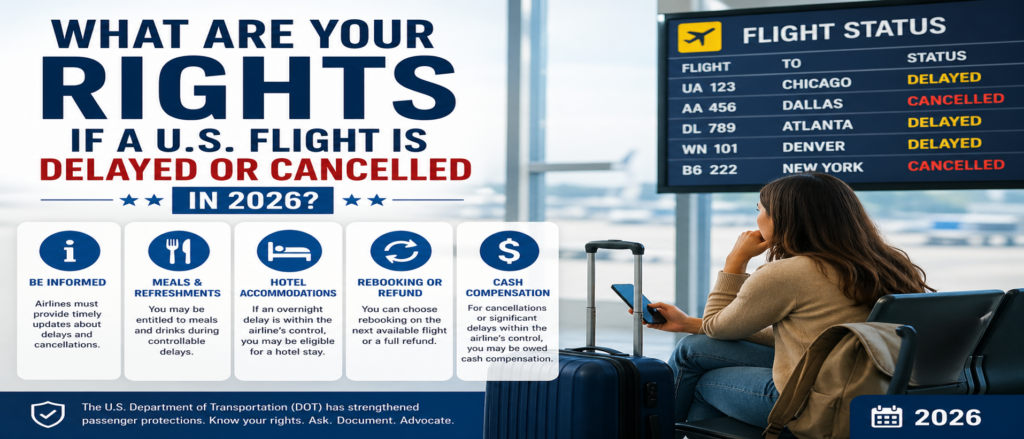
What Are Your Rights if a U.S. Flight Is Delayed or Cancelled in 2026?
30 Apr. 2026
If your flight in the United States is delayed or cancelled in 2026, your most important right is usually the right to a refund, not automatic compensation.
That distinction matters.
In the U.S., airlines generally must refund you if your flight is cancelled and you choose not to travel. They must also refund you if your flight is significantly delayed or significantly changed and you decide not to accept the alternative offered.
What the airline must cover beyond that depends on two separate questions:
- Was the disruption within the airline’s control?
- Has that airline committed to providing meals, hotel accommodation, ground transportation, or rebooking support in that situation?
That is where many travelers get confused. A long delay does not automatically mean cash compensation. An overnight disruption does not automatically mean a free hotel. In many cases, those benefits depend on the airline’s customer service commitments for controllable delays and cancellations rather than a universal U.S. compensation rule.
Here is the practical version:
| Situation | What you may be entitled to |
| Flight is cancelled and you do not travel | Refund |
| Flight is significantly delayed or significantly changed and you decline travel | Refund |
| Controllable delay or cancellation | Airline-specific commitments may include meals, hotel, ground transport, or rebooking |
| Weather, air traffic control, or security disruption | Support may be limited, and extra amenities may not apply |
For travelers, the real mistake is assuming that “delayed” and “protected” mean the same thing. They do not.
The smarter way to evaluate your rights is to separate three things:
- what DOT rules require
- what the airline has committed to provide
- what costs you may still have to cover yourself if the disruption falls outside both
That is exactly where the DOT dashboard becomes useful, and where many travelers realize too late that refund rights and disruption-cost protection are not the same thing.
What Does the DOT Airline Cancellation and Delay Dashboard Show in 2026?
The U.S. Department of Transportation airline dashboard is a comparison tool, not a compensation law.
Its job is to show, in one place, what major U.S. airlines say they will provide when a delay or cancellation is caused by something within the airline’s control. That includes commitments such as rebooking, meal vouchers, hotel accommodation for overnight disruptions, and ground transportation to and from a hotel where applicable.
That distinction matters because many travelers assume the dashboard creates new passenger rights. It does not. The dashboard summarizes airline commitments. If an airline displays a commitment there, the Department of Transportation can hold that airline accountable for honoring it. If the airline has not made that commitment, the dashboard does not create it for them.
The dashboard is most useful before you book, not after your trip has already gone wrong.
It helps answer a practical question that travelers often ignore until it is too late: if this airline causes a major disruption, what support has it publicly committed to provide?
Here is the simplest way to read it:
| What the dashboard shows | What the dashboard does not do |
| Airline commitments for controllable delays and cancellations | Create universal compensation rights |
| Side-by-side comparison across major airlines | Guarantee cash compensation for delays |
| Whether an airline has committed to meals, hotel, or rebooking support | Apply the same way to weather, air traffic control, or security disruptions |
| A transparency and accountability tool | Replace the airline’s full contract of carriage or customer service plan |
The most important phrase on the dashboard is “within the airline’s control.”
If the disruption was caused by airline operations, such as maintenance issues, crew scheduling problems, or other internal operational failures, the dashboard commitments may apply. If the disruption was caused by weather, air traffic control restrictions, airport constraints, or security events, those commitments may not apply in the same way.
That is why two passengers with equally bad delays can end up with very different outcomes.
One may receive meal vouchers, hotel accommodation, and ground transportation because the airline caused the disruption and had committed to those services. Another may receive only rebooking options because the disruption was outside the airline’s control or because that airline never committed to broader support in that scenario.
For a traveler, the dashboard should be used as a risk-screening tool.
Price tells you what the ticket costs. Schedule tells you when you leave. The dashboard tells you how exposed you may be when things fall apart.
That is the real value. It does not prevent a disruption. It helps you judge, before booking, how much of the disruption cost the airline is likely to absorb and how much may still fall on you.
When Is a Flight Disruption Considered Within the Airline’s Control?
A flight disruption is considered within the airline’s control when the airline itself caused the delay or cancellation through its own operations.
This is one of the most important distinctions in the entire U.S. airline-delay system because the DOT dashboard commitments apply to controllable disruptions, not to every delay a passenger experiences.
In plain language, a controllable disruption usually means the airline could have prevented or managed the problem within its own operation.
Common examples include:
- aircraft maintenance issues
- crew scheduling or crew availability problems
- cabin cleaning delays
- baggage loading delays
- fueling delays
Those are the kinds of situations the DOT itself treats as examples of delays or cancellations caused by the airline.
By contrast, a disruption is generally not treated as within the airline’s control when the cause comes from outside the airline’s own operation.
That can include things such as:
- severe weather
- air traffic control restrictions
- airport operating constraints
- security events or other government-directed disruptions
In those situations, the airline may still rebook you or assist in limited ways, but the broader dashboard commitments for meals, hotel accommodation, or ground transportation may not apply in the same way.
This is where travelers get tripped up.
A passenger sees an overnight delay and assumes the airline owes a hotel. That is not automatically true. The real question is not just how bad the disruption was. The real question is why it happened.
Two travelers can face the same six-hour delay and still have very different outcomes:
| Scenario | Likely treatment |
| Delay caused by crew scheduling or maintenance | May trigger airline commitments shown on the DOT dashboard |
| Delay caused by thunderstorms or air traffic restrictions | May not trigger the same commitments beyond rebooking or refund rights |
That is why “within airline control” is not a minor technical phrase. It is the dividing line between a disruption where the airline may have committed to absorb some of your costs and a disruption where much more of the burden may stay with you.
Controllable delay = the airline caused the problem.
Non-controllable delay = something outside the airline’s operation caused the problem.
Once you understand that distinction, the rest of the system becomes easier to read:
- refund rights depend on DOT rules for cancellations and significant delays or changes
- meal, hotel, and transportation support often depend on airline commitments for controllable disruptions
- your out-of-pocket risk rises fast when the disruption falls outside those commitments
That is why the smartest travelers do not just ask, “Was my flight delayed?” They ask, “What caused the delay, and does that cause trigger airline commitments?” That is the question that actually determines what help you may receive.
This section is grounded in the current DOT dashboard definition that a controllable cancellation or delay is essentially one caused by the airline, with examples such as maintenance, crew problems, cabin cleaning, baggage loading, and fueling.
When Are Airlines Required to Refund You for a Delayed or Cancelled Flight?
In 2026, the clearest passenger protection in the United States is the right to a refund when you choose not to travel after a cancellation or a significant flight change.
If an airline cancels your flight and you do not take the alternative offered, you are generally entitled to a refund. The same applies when the airline makes a significant change to your itinerary and you decide not to travel on the revised booking.
That is the rule travelers should understand first: a refund is not based only on whether the airline says “sorry” or offers a voucher. It is based on whether the disruption materially changed your trip and whether you declined the alternative.
For domestic flights, a significant change generally includes a departure that is 3 hours earlier than scheduled or an arrival that is 3 hours later than scheduled. For international flights, the threshold is generally 6 hours earlier or later. Those thresholds matter because they move the issue out of the “minor inconvenience” category and into the refund-rights category.
Here is the practical version:
| Situation | Refund right likely applies? |
| Flight is cancelled and you do not travel | Yes |
| Flight is significantly delayed or significantly changed and you decline the new itinerary | Yes |
| Airline offers only a travel credit but you qualify for a refund and do not accept the credit | Yes |
| Delay is minor and you still travel | Usually no |
| You voluntarily choose not to travel even though the flight operates as scheduled | No |
This is where many travelers get misled.
Airlines may first offer rebooking, vouchers, or travel credits. That does not automatically erase your refund right if the disruption qualifies and you do not accept the substitute. If the flight was cancelled or significantly changed and you choose not to travel, the refund obligation is tied to that fact pattern, not to the airline’s preferred workaround.
Refunds also need to be returned to the original form of payment within the required timelines. That is part of what made the DOT’s refund framework more meaningful: the issue is no longer just whether a refund is theoretically owed, but whether it must be processed automatically and promptly.
This section also helps draw a clean line between refund rights and dashboard commitments.
A refund is a rule-based consumer protection.
Meals, hotel accommodation, and ground transportation are usually not universal refund rights. Those depend much more on whether the disruption was within the airline’s control and what that airline has committed to provide in that situation.
That distinction is critical because travelers often bundle everything together under the word “compensation.” In reality, U.S. airline disruption protection operates in layers:
- refund rights for cancellations and significant changes
- rebooking options offered by the airline
- additional amenities based on airline-specific commitments for controllable disruptions
- remaining out-of-pocket costs that may still fall on the traveler
The expert takeaway is simple:
If your trip is cancelled or significantly changed and you do not want the alternative, ask about the refund first. Do not start with meal vouchers, miles, or goodwill credits. Those are secondary. The refund right is the most important protection you have.
Do U.S. Airlines Have to Pay for Meals, Hotels, or Ground Transportation During Delays?
Usually not as a matter of universal law.
In the United States, airlines are not generally required across the board to pay cash compensation simply because a flight is delayed. Support such as meal vouchers, overnight hotel accommodation, or transportation to and from a hotel usually depends on two things:
- whether the disruption was within the airline’s control
- whether that airline has publicly committed to provide that support in that situation
That is why travelers often get confused. They assume a long delay automatically triggers a hotel or meal voucher. In practice, that is not how the U.S. system works.
For controllable delays and cancellations, many major airlines have committed through the DOT dashboard to provide specific forms of assistance. But those commitments are airline-specific and situation-specific. They are not a blanket federal compensation regime.
Here is the distinction that matters most:
| Type of support | Is it universally required in the U.S.? |
| Refund after cancellation or significant change if you decline travel | Yes, when the rule applies |
| Rebooking on the airline’s next available option | Common practice, often offered |
| Meal vouchers during controllable delays | Airline-specific commitment |
| Hotel stay for overnight controllable disruption | Airline-specific commitment |
| Ground transportation to and from hotel | Airline-specific commitment |
| Cash compensation for ordinary delay | No general U.S. rule |
The phrase “within the airline’s control” is what makes this section work.
If the airline caused the disruption through maintenance issues, crew scheduling problems, fueling delays, baggage loading delays, or similar operational failures, dashboard commitments may apply. If the delay was caused by weather, air traffic control restrictions, airport limitations, or security events, those same commitments may not apply.
That means the same passenger experience can lead to very different outcomes:
| Delay scenario | What support may happen |
| Overnight delay caused by airline maintenance | Hotel, meal voucher, and possibly ground transport may apply if the airline committed to them |
| Overnight delay caused by thunderstorms | Hotel and meal support may be limited or not provided |
| Multi-hour controllable delay | Meal voucher may apply depending on airline commitment |
| Multi-hour non-controllable delay | Rebooking may be offered, but broader amenities may not apply |
This is the gap many travelers do not see until they are standing at the airport.
The airline may still get you onto another flight. That does not mean it will absorb the cost of your meals, hotel room, or local transportation. In the U.S., those protections are much narrower than many passengers expect.
That is why the DOT dashboard matters. It helps you compare, before booking, whether an airline has committed to cover those costs during controllable disruptions. It does not mean every delay leads to those benefits. It means some airlines have publicly said they will provide them under defined conditions, and others have not.
The practical takeaway is simple:
A delayed flight does not automatically mean free meals or a free hotel.
An overnight cancellation does not automatically mean reimbursement.
The cause of the disruption and the airline’s stated commitment are what determine whether those benefits are likely to apply.
How Should You Use the DOT Dashboard Before Booking a Flight?
Most travelers compare flights based on fare, timing, and baggage rules. That is not enough.
If two flights look similar on price and schedule, the better choice may be the airline that has made stronger commitments for controllable delays and cancellations. The DOT dashboard helps you compare that risk before you book.
This matters because the cheapest ticket is not always the lowest-cost decision once a disruption happens.
A flight that saves you a small amount upfront can become the more expensive choice if the airline provides limited support during an overnight cancellation or a long controllable delay.
Use the dashboard as a disruption-risk filter, not as a replacement for fare comparison.
Here is the smarter way to evaluate flights:
| What most travelers compare | What a better booking decision also compares |
| Ticket price | Airline commitments during controllable disruptions |
| Departure and arrival times | Whether meals may be provided during long controllable delays |
| Baggage fees | Whether overnight hotel accommodation may be provided |
| Loyalty program preference | Whether ground transportation to a hotel may be covered |
| Number of stops | How the airline handles rebooking when it causes the disruption |
The practical booking question is not just, “Which flight is cheaper?”
It is also, “If this airline causes a serious disruption, what has it publicly committed to do for me?”
That question becomes more important in situations such as:
- late evening departures
- tight connections
- travel with children or older parents
- trips tied to cruises, tours, weddings, visa appointments, or other time-sensitive plans
- itineraries where an overnight disruption would create immediate hotel and meal costs
In those situations, the dashboard can help you make a better tradeoff between price and exposure.
A simple decision process works well:
| Step | What to check |
| 1 | Compare price, schedule, and routing |
| 2 | Check whether the airline has stronger commitments for meals, hotel, and ground transport during controllable disruptions |
| 3 | Consider how expensive an overnight delay would be for your trip |
| 4 | Decide whether the cheaper fare is still worth it once disruption risk is considered |
The dashboard does not tell you which airline will delay you less. It tells you which airline has committed to support you better if it causes the problem.
That is a much more useful planning tool than many travelers realize.
For expert-style decision making, the right mindset is this:
Do not evaluate a flight only by the cost of the ticket.
Evaluate it by the cost of failure as well.
That is the real value of the DOT dashboard. It gives you one more layer of information before booking so you can judge not only convenience, but also how much disruption risk you may be taking on.
What Costs Can Still Fall on You Even if the Airline Rebooks You?
Rebooking does not mean you are financially protected.
An airline may put you on another flight and still leave you with meaningful out-of-pocket costs, especially if the disruption is not covered by a refund rule or by the airline’s controllable-delay commitments.
That is the gap many travelers miss.
They hear “we have rebooked you” and assume the problem has been solved. In reality, rebooking often addresses only the flight itself. It does not automatically cover the extra costs created by the disruption around the flight.
Common out-of-pocket expenses can include:
- hotel stay during an overnight disruption
- meals during a long delay
- taxi, rideshare, or shuttle costs
- airport parking extensions
- missed prepaid bookings such as hotels, tours, cruises, or event tickets
- extra childcare or local logistics costs
- replacement transportation when a missed connection affects the rest of the trip
Here is the practical breakdown:
| Disruption-related cost | May still fall on you? |
| New flight on the same airline | Often covered through rebooking |
| Refund if you decline a cancelled or significantly changed flight | May apply under DOT rules |
| Hotel during overnight disruption | Often depends on airline commitment and cause of delay |
| Meals during long delay | Often depends on airline commitment and cause of delay |
| Local transportation to hotel or back to airport | Often depends on airline commitment |
| Missed cruise, tour, hotel night, or event | Often falls on traveler |
| Lost time and inconvenience | Usually not compensated |
This is where the financial exposure becomes real.
An overnight disruption can easily create a cluster of costs rather than one single expense. Even when the ticket itself is handled, the surrounding trip costs can keep growing.
A typical example looks like this:
| Expense category | Typical impact |
| One hotel night near airport | Moderate to high |
| Meals for one day | Moderate |
| Taxi or rideshare | Low to moderate |
| Missed prepaid reservation or event | Moderate to high |
| Connection-related changes to the rest of itinerary | Moderate to high |
The important point is not the exact number. The important point is that airline support usually narrows as you move away from the ticket itself.
That is why a traveler can be “rebooked” and still be worse off financially.
This is especially relevant for:
- families traveling together
- older travelers who need more predictable arrangements
- international visitors unfamiliar with local airport logistics
- travelers with late-night arrivals
- trips tied to fixed events or onward travel
The expert takeaway is simple:
The flight is only one part of the travel cost.
When disruption happens, the uncovered costs around the flight are often what hurt the most.
That is the real gap between airline rebooking and full trip protection.
When Does Travel Insurance Matter for Flight Delays and Missed Connections?
Travel insurance matters when the costs created by a disruption are larger than the airline’s responsibility.
That is the real use case.
The DOT dashboard can help you understand what an airline may provide during a controllable delay or cancellation. It does not protect you from all of the financial consequences of disruption. It does not cover every hotel stay, every meal, every missed connection, or every prepaid booking that unravels because your itinerary breaks.
That is where travel insurance becomes relevant.
It is most useful when the disruption creates costs that sit outside:
- your refund rights
- the airline’s voluntary commitments
- your own ability or willingness to absorb the loss
In practical terms, travel insurance becomes much more valuable in situations such as:
| Travel situation | Why insurance matters more |
| Tight onward connections | A missed connection can trigger additional transport or lodging costs |
| Overnight disruptions | Hotel, meals, and local transportation may not be fully covered by the airline |
| Prepaid hotels, tours, or cruises | A delay can cause losses that the airline will not reimburse |
| International travel | Rebooking problems can become more expensive and harder to manage |
| Family travel | Multiple people multiply hotel, meal, and transport costs quickly |
| Time-sensitive trips | Missed appointments, departures, or events can create cascading losses |
This is the point many travelers get wrong.
They think of travel insurance as something for medical emergencies only, or as an optional add-on for nervous travelers. That is too narrow.
For flight disruptions, the real value of travel insurance is often not that it replaces the airline. It fills the gap where the airline stops.
That gap can include:
- delay-related meals and accommodation
- missed connection expenses
- additional transportation costs
- non-refundable trip components that are lost because the itinerary failed
Here is the cleaner decision framework:
| Question | If the answer is yes, insurance matters more |
| Would an overnight delay create hotel and meal costs you would notice? | Yes |
| Would a missed connection affect prepaid reservations or onward travel? | Yes |
| Are you taking a complex itinerary with little margin for error? | Yes |
| Are you assuming the airline will cover everything if it causes the delay? | That assumption is risky |
Travel insurance is not a substitute for understanding airline rules. It is protection against the parts of disruption that airline rules and airline commitments do not fully absorb.
That is why the smartest way to think about it is not “Will the airline help?”
It is “If the airline’s help stops at the ticket, what costs are still left with me?”
What Are the Most Common Misunderstandings About U.S. Airline Delay Rules?
Most confusion about U.S. airline delay rules comes from assuming that a bad travel experience automatically creates a legal right to compensation.
That assumption is wrong.
In the United States, delay-related protection is narrower than many travelers expect. Refund rights can be strong in the right situation, but meals, hotels, ground transportation, and broader disruption costs often depend on airline commitments and the cause of the disruption.
These are the most common misunderstandings:
| Misunderstanding | What is actually true |
| A long delay automatically means the airline owes me compensation | Not usually. A long delay does not automatically create a cash compensation right in the U.S. |
| If my flight is cancelled, the airline must give me whatever form of reimbursement I ask for | Not exactly. You may have a refund right if you decline travel, but the details depend on the situation and whether you accept alternatives |
| If the airline rebooks me, I have no further rights | Wrong. Rebooking does not erase possible refund rights if the original disruption qualifies and you choose not to travel |
| If I am stuck overnight, the airline must pay for a hotel | Not universally. Hotel support often depends on whether the disruption was within the airline’s control and whether that airline committed to hotel coverage |
| The DOT dashboard tells me what airlines are legally required to do in every case | No. It shows airline commitments for controllable delays and cancellations, not a universal compensation system |
| All delays are treated the same way | No. The cause of the delay matters significantly |
| Weather delays and airline-caused delays should lead to the same support | They often do not. Weather and other external disruptions are usually treated differently from controllable operational failures |
| Travel insurance is only for medical emergencies | No. It can also matter when disruption creates hotel, meal, transport, or missed-connection costs the airline does not cover |
The biggest mistake is emotional reasoning.
A traveler thinks, “This was clearly unfair, so the airline must owe me something substantial.”
That is understandable, but it is not how the U.S. framework works. The system is not built around a general fairness standard. It is built around a narrower mix of:
- refund rights for cancellations and significant changes
- airline commitments for controllable disruptions
- limited or no mandatory coverage for many surrounding trip costs
Another common mistake is using the word “compensation” too loosely.
Travelers often use that word to mean all of the following:
- refund of the unused ticket
- meal vouchers
- hotel accommodation
- cash payout for inconvenience
- reimbursement for missed plans
Those are not the same thing.
If you want to understand your actual position, you need to separate them.
| Category | Better question to ask |
| Refund | Am I entitled to my money back if I do not travel? |
| Rebooking | What alternative is the airline offering? |
| Delay support | Has the airline committed to meals, hotel, or transportation for this type of disruption? |
| Out-of-pocket losses | What costs are still mine even after rebooking? |
The expert takeaway is simple:
Do not ask only, “Was my flight delayed?”
Ask four better questions:
- Was the flight cancelled or significantly changed?
- Did I accept the airline’s alternative?
- Was the disruption within the airline’s control?
- What costs remain outside the airline’s responsibility?
Those four questions lead to a much more accurate answer than the vague assumption that every serious delay should produce automatic compensation.
FAQ: U.S. Airline Delay Rules, Refunds, Hotels, and the DOT Dashboard
Does a delayed flight automatically qualify for compensation in the United States?
No. In the United States, a delayed flight does not automatically create a right to cash compensation. Your strongest protection is usually the right to a refund if the flight is cancelled or significantly changed and you choose not to travel. Support such as meals, hotel accommodation, or ground transportation often depends on whether the disruption was within the airline’s control and whether the airline committed to provide that support.
Can I get a refund if my flight is delayed but not cancelled?
Yes, if the delay is significant and you decide not to travel on the revised itinerary. In that situation, a refund may apply even if the flight was technically delayed rather than cancelled. What matters is whether the disruption materially changed your trip and whether you declined the alternative.
Do airlines have to provide a hotel for an overnight delay?
Not in every case. A hotel is not automatically required just because the disruption lasts overnight. Hotel support usually depends on whether the delay or cancellation was within the airline’s control and whether that airline has committed to hotel accommodation for that type of disruption.
Do airlines have to pay for meals during a long delay?
Not as a universal rule. Some airlines commit to meal vouchers or meal reimbursement for controllable delays, but that is not the same as a blanket federal requirement for every delayed flight.
What does “within the airline’s control” mean?
It generally means the airline caused the disruption through its own operations. Common examples include maintenance problems, crew scheduling failures, fueling delays, baggage loading delays, or similar operational issues. Weather, air traffic control restrictions, airport constraints, and security events are generally treated differently.
Does the DOT dashboard create new passenger rights?
No. The DOT dashboard is a transparency tool. It shows what airlines have committed to provide for controllable delays and cancellations. It does not create a universal compensation system, but it does make it easier for travelers to compare airline commitments before booking.
If the airline rebooks me, can I still ask for a refund?
If the disruption qualifies and you choose not to accept the alternative, a refund may still apply. Rebooking is often the airline’s first response, but it does not automatically erase a passenger’s refund rights when a cancellation or significant schedule change has occurred.
Are weather delays treated the same as airline-caused delays?
No. Weather delays and other external disruptions are usually treated differently from delays caused by the airline’s own operations. That difference affects whether meals, hotel accommodation, or other support may apply.
Does travel insurance cover flight delays and missed connections?
It can, depending on the policy. Travel insurance may help with costs such as hotel stays, meals, missed connections, and other disruption-related expenses that the airline does not cover. It is most useful when the financial consequences of the delay go beyond the ticket itself.
What is the smartest way to use the DOT dashboard before booking?
Use it as a disruption-risk comparison tool. Compare not just fare and schedule, but also what the airline has committed to provide during controllable delays and cancellations. That gives you a better sense of how much support you may receive if the airline causes the disruption.