

B1/B2 Visa Refused? 214(b) vs. 221(g) Explained
11 Sep. 2026
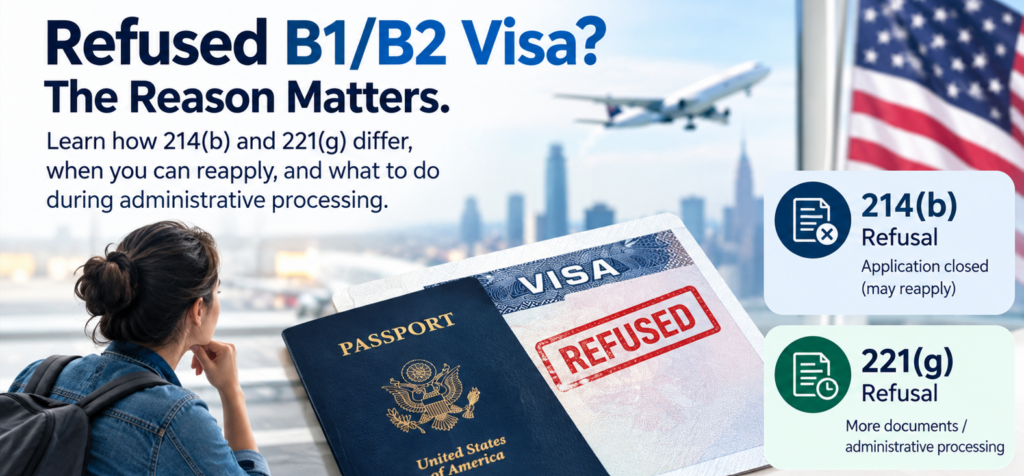
Refused B1/B2 visa? The reason matters. Learn how 214(b) and 221(g) differ, when you can reapply, and what to do during administrative processing
A B1/B2 visitor visa application does not always end in approval.
Some applicants receive a refusal under Section 214(b) of the Immigration and Nationality Act, while others may receive a 221(g) refusal because additional documents, information, or administrative processing are required.
Although both may appear as a visa refusal, they mean different things and the next steps are not the same.
Understanding what the refusal means can help you decide whether you need to provide more information, wait for additional processing, or submit a new visa application.
Quick Answer: What Does a B1/B2 Visa Refusal Mean?
A B1/B2 visa may be refused for different reasons.
A 214(b) refusal generally means that the applicant did not sufficiently establish eligibility for the requested nonimmigrant visa or overcome the presumption of immigrant intent. That application is closed, although the applicant may apply again.
A 221(g) refusal generally means the consular officer does not yet have enough information to conclude that the applicant qualifies. Additional documents may be requested, or the case may require administrative processing.
Why Can a B1/B2 Visa Be Refused?
A B1/B2 visa can be refused for several reasons. Two of the most common refusal categories applicants encounter are Section 214(b) and Section 221(g) of the Immigration and Nationality Act.
They mean very different things.
A 214(b) refusal generally means the consular officer was not satisfied that the applicant qualified for the requested nonimmigrant visa and/or did not sufficiently overcome the legal presumption of immigrant intent.
A 221(g) refusal generally means the officer could not yet conclude that the applicant was eligible because additional documents, information, or administrative processing were required.
What Is the Difference Between a 214(b) and 221(g) Refusal?
| Refusal | What It Generally Means | What Happens Next |
| INA 214(b) | The applicant did not sufficiently establish eligibility for the nonimmigrant visa and/or did not overcome the presumption of immigrant intent | The application is closed. There is no appeal process for that application. The applicant may submit a new visa application in the future, particularly if circumstances have materially changed or additional relevant information is available |
| INA 221(g) | The consular officer does not yet have enough information to conclude that the applicant qualifies, or additional administrative processing is required | The applicant may be asked to provide specific documents or information, or wait while administrative processing is completed |
| Other visa ineligibility | Other provisions of U.S. immigration law may make an applicant ineligible for a visa | The consequences depend on the specific legal ground. In some situations, a waiver may be available; in others, it may not be |
The distinction matters because a 221(g) case is not necessarily the same as a final 214(b) decision.
What Does a 214(b) Visa Refusal Mean?
Section 214(b) applies to most nonimmigrant visa applicants, including B1/B2 applicants.
Under U.S. immigration law, most nonimmigrant visa applicants are presumed to be intending immigrants until they establish that they qualify for the temporary nonimmigrant status they are requesting.
A 214(b) refusal may mean that the applicant:
- Did not sufficiently demonstrate that the planned trip fits the B1/B2 visa category
- Did not sufficiently establish that the visit would be temporary
- Did not sufficiently demonstrate circumstances outside the United States that support an intention to leave after the visit
Consular officers look at each application individually and may consider the applicant’s circumstances, travel plans, financial resources, and ties outside the United States.
What Are “Strong Ties” Outside the United States?
There is no universal checklist of documents or circumstances that guarantees someone has sufficient ties.
Ties vary from person to person.
Examples may include:
| Type of Tie | Examples |
| Employment | A continuing job, approved leave, professional responsibilities |
| Business | Ownership or management responsibilities in an ongoing business |
| Family | Spouse, children, parents, or other significant family responsibilities outside the United States |
| Home and property | A home, property, or established residence |
| Financial circumstances | Ongoing financial commitments, assets, income, or business interests |
| Community and personal circumstances | Established responsibilities and relationships in the applicant’s home country |
| Travel history | Previous international travel and compliance with immigration rules |
The Department of State specifically gives examples such as a person’s job, home, and relationships with family and friends while emphasizing that every applicant’s circumstances are different.
This is why simply carrying property papers or showing a large bank balance does not automatically establish visa eligibility.
The officer considers the application as a whole rather than relying on one document or financial figure.
Can You Appeal a 214(b) Refusal?
No. There is no appeal process for a 214(b) refusal.
The refusal applies to that specific visa application. Once the case is closed, the consular section cannot take further action on that application.
You may apply again, but a new application normally requires:
- A new visa application
- Payment of the applicable visa application fee
- A new interview appointment
The Department of State advises that an applicant reapplying after a 214(b) refusal should be able to present significant changes in circumstances or additional relevant information compared with the previous application.
Should You Reapply Immediately After a 214(b) Refusal?
There is no rule requiring an applicant to wait a specific number of months before reapplying.
However, submitting essentially the same application with the same circumstances immediately after a refusal may not address the reason the previous application failed.
Before reapplying, consider whether something meaningful has changed or whether important relevant information was not adequately presented previously.
Changes could relate to the applicant’s employment, family circumstances, travel plans, financial situation, or other relevant factors. However, no individual change automatically guarantees approval.
Recent applicant discussions show that people commonly wonder whether events such as marriage, a new job, higher income, or additional travel history count as meaningful changes after a 214(b) refusal. Those factors may form part of the overall circumstances, but the Department of State does not provide a formula that guarantees approval based on any particular change.
Do not invent a new travel purpose, alter facts, or create documents simply because the previous application was refused.
What Does a 221(g) Refusal Mean?
A refusal under Section 221(g) generally means the consular officer does not currently have enough information to determine that the applicant qualifies for the visa.
There are two common situations.
1. Additional Documents or Information Are Required
The consular officer may ask you to submit specific information or documents before the application can be reconsidered.
If further documents are required, the Embassy or Consulate should tell you what is needed and how it should be submitted.
Once the requested information is provided, the visa application can be reassessed to determine whether the applicant qualifies.
2. The Application Requires Administrative Processing
Some applications require additional review after the visa interview.
In such a case, the application remains refused under 221(g) while administrative processing is underway.
Once the review is completed, the consular officer may determine that the applicant qualifies for the visa or may determine that the applicant remains ineligible.
Administrative processing therefore should not automatically be interpreted as either an eventual approval or a final denial.
What Should You Do After a 221(g) Refusal?
The next step depends on the instructions you receive.
| Situation | What You Should Do |
| Documents were requested | Follow the Embassy or Consulate’s instructions and submit the requested information as accurately and promptly as possible |
| Administrative processing is required | Wait for the consular post to complete its review and follow any instructions you receive |
| You are unsure what is required | Review the written notice given to you and the instructions from the Embassy or Consulate handling your case |
| Your circumstances change while the case is pending | Follow the consular post’s instructions regarding additional information |
Where a 221(g) refusal is based on missing documentation, applicants generally have one year from the refusal date to provide the requested information.
If the required information is not provided within one year, the applicant generally needs to submit a new visa application and pay another application fee.
Does Administrative Processing Mean Your Visa Will Be Denied?
Not necessarily.
Administrative processing means additional review is required before the consular officer can complete the case.
Processing times vary based on the individual circumstances of each application. The Department of State currently advises applicants, except in emergency travel situations, to wait at least 180 days from the interview or submission of supplemental documents, whichever is later, before making a status inquiry.
A case in administrative processing should therefore not be interpreted as either an approval or a final denial while that review remains pending.
Applicants should follow instructions from the Embassy or Consulate handling the case rather than relying on another person’s processing timeline.
Does Carrying More Documents Increase Your Chances of Approval?
Not automatically.
A B1/B2 visa decision is based on the applicant’s eligibility and circumstances, not the thickness of the document folder.
Relevant documentation can be useful when a consular officer requests evidence, but carrying dozens of unnecessary documents does not guarantee approval.
The important points are that your:
- DS-160 is accurate
- Interview answers are truthful and consistent
- Purpose of travel is clear
- Financial arrangements make sense
- Overall circumstances support a legitimate temporary visit
Each visa application is assessed individually.
What Happens After Your B1/B2 Visa Is Approved?
Getting the visa is only one part of traveling to the United States.
A B1/B2 visa may remain valid for several years, but the visa expiration date does not determine how long you are permitted to remain in the United States during an individual trip.
U.S. Customs and Border Protection determines your admission and authorized stay when you enter the country, and your I-94 record becomes particularly important.
Our next guide explains visa validity, the 10-year B1/B2 visa, I-94 records, how long visitors can stay, B2 extensions, and visitor medical insurance for longer U.S. trips.
Read Next: B1/B2 Visa Stay in the USA: Validity, I-94, Extensions and Visitor Insurance →
Frequently Asked Questions
Does a 214(b) refusal permanently affect future B1/B2 visa applications?
No. A 214(b) refusal applies to that specific application and is not automatically permanent. You may apply again, but the Department of State recommends being able to show significant changes in circumstances or additional relevant information when reapplying.
If I submit the documents requested under 221(g), do I need to pay the visa fee again?
Generally, not if you provide the requested information within the allowed one-year period for that 221(g) case. If you do not submit the required information within one year, you generally need to reapply and pay a new application fee.
Can my relative in the United States contact the Embassy about my visa refusal?
Visa case records are generally confidential, so information is normally provided to the applicant. Certain information may be shared with authorized representatives, U.S. sponsors, members of Congress, or others in limited circumstances and with appropriate permission.
How long should I wait before asking about administrative processing?
Processing time varies by case. Except for emergency travel involving situations such as serious illness, injury, or death in the immediate family, the Department of State currently advises waiting at least 180 days from the interview or submission of supplemental documents, whichever is later, before making a status inquiry.