
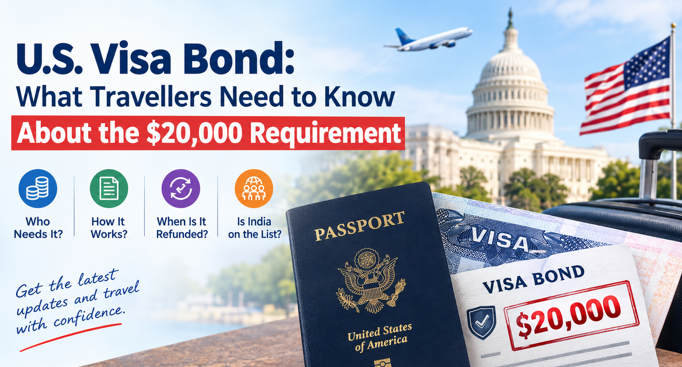

Last verified: October 5, 2026. The U.S. Department of State currently lists 50 nationalities subject to visa bonds. India is not on the list. Because the list can change, check the official State Department page before applying.
The U.S. visa bond programme requires certain B1/B2 visa applicants from 50 countries to post a bond of $10,000, $15,000 or $20,000 before their visa can be issued. The requirement does not apply to every visitor visa applicant, and India is not currently on the U.S. Department of State’s list of countries subject to the bond.
The programme began as a pilot in August 2025 and was made permanent through a State Department final rule in August 2026. The country list below reflects what the Department of State has published to date — but agencies update these lists, so confirm the current status on the Department of State’s official visa bond page before relying on it for an actual application.
So, who has to pay the bond, how does it work, when can the money be refunded, and what does the programme mean for Indian travellers?
What Is the U.S. Visa Bond Programme?
The U.S. visa bond programme allows a consular officer to require certain applicants for B1/B2 visitor visas to post a financial bond as a condition of visa issuance.
B1 visas generally cover temporary business-related travel, while B2 visas cover tourism and other permitted visitor activities.
The programme operates under Section 221(g)(3) of the Immigration and Nationality Act (INA). The Department of State’s August 2026 final rule made it permanent.
The bond is separate from the normal visa application fee. It’s refundable, not a cost of applying — the money is returned when the conditions for cancellation are met, and forfeited only on a breach.
Why Has the U.S. Introduced the Visa Bond?
The programme stems from concerns on visa overstays. The Department of State says country eligibility is based in part on B1/B2 visa overstay rates reported through the Department of Homeland Security’s Entry/Exit Overstay Report.
That doesn’t mean every applicant from a country with a history of overstays automatically pays a bond. The requirement applies only to nationals of countries currently designated under the programme, and the specific amount is set during the visa process itself.
Is India on the U.S. Visa Bond List?
No. India is not currently on the U.S. visa bond list.
The Department of State’s current list names 50 countries, and India is not among them. An Indian citizen applying for a B1/B2 visa is not required to post a bond simply because of their nationality.
This is worth noting because several other South Asian countries — Bangladesh, Bhutan and Nepal — are currently included.
The list can change, so anyone applying for a U.S. visa in the future should check the Department of State’s current guidance at the time of application rather than rely on this article.
Which Countries Are Subject to the U.S. Visa Bond?
As of the Department of State’s most recently published list, 50 countries are subject to the visa bond programme. (Note: “Georgia” below refers to the Eurasian country, not the U.S. state.)
| Country | Implementation Date |
|---|---|
| Algeria | January 21, 2026 |
| Angola | January 21, 2026 |
| Antigua and Barbuda | January 21, 2026 |
| Bangladesh | January 21, 2026 |
| Benin | January 21, 2026 |
| Bhutan | January 1, 2026 |
| Botswana | January 1, 2026 |
| Burundi | January 21, 2026 |
| Cabo Verde | January 21, 2026 |
| Cambodia | April 2, 2026 |
| Central African Republic | January 1, 2026 |
| Cote D’Ivoire | January 21, 2026 |
| Cuba | January 21, 2026 |
| Djibouti | January 21, 2026 |
| Dominica | January 21, 2026 |
| Ethiopia | April 2, 2026 |
| Fiji | January 21, 2026 |
| Gabon | January 21, 2026 |
| The Gambia | October 11, 2025 |
| Georgia | April 2, 2026 |
| Grenada | April 2, 2026 |
| Guinea | January 1, 2026 |
| Guinea-Bissau | January 1, 2026 |
| Kyrgyz Republic | January 21, 2026 |
| Lesotho | April 2, 2026 |
| Malawi | August 20, 2025 |
| Mauritania | October 23, 2025 |
| Mauritius | April 2, 2026 |
| Mongolia | April 2, 2026 |
| Mozambique | April 2, 2026 |
| Namibia | January 1, 2026 |
| Nepal | January 21, 2026 |
| Nicaragua | April 2, 2026 |
| Nigeria | January 21, 2026 |
| Papua New Guinea | April 2, 2026 |
| Sao Tome and Principe | October 23, 2025 |
| Senegal | January 21, 2026 |
| Seychelles | April 2, 2026 |
| Tajikistan | January 21, 2026 |
| Tanzania | October 23, 2025 |
| Togo | January 21, 2026 |
| Tonga | January 21, 2026 |
| Tunisia | April 2, 2026 |
| Turkmenistan | January 1, 2026 |
| Tuvalu | January 21, 2026 |
| Uganda | January 21, 2026 |
| Vanuatu | January 21, 2026 |
| Venezuela | January 21, 2026 |
| Zambia | August 20, 2025 |
| Zimbabwe | January 21, 2026 |
How Much Is the U.S. Visa Bond?
The bond can be $10,000, $15,000, or $20,000. The amount is determined by the consular officer during the visa interview.
Being required to post a bond doesn’t itself guarantee visa issuance — the bond is one part of the process and doesn’t replace the normal B1/B2 eligibility requirements.
How Do Applicants Pay the U.S. Visa Bond?
Applicants required to post a bond must complete DHS Form I-352 and pay through the U.S. Department of the Treasury’s Pay.gov system.
The bond can be paid by the applicant or by a third party — a family member, friend, or business associate. The person named as the obligor on Form I-352 must be the person making the payment, since that’s also the person to whom the bond is returned if the conditions are met.
Do Not Pay the Visa Bond Before Being Instructed
Applicants should not submit Form I-352 or make the payment on their own initiative. The Department of State’s process is to complete this only after a consular officer directs the applicant to post the bond, using the Pay.gov link provided at that time — not a third-party site offering to collect it.
The bond is paid and refunded in U.S. dollars; the person posting it bears any exchange-rate fluctuation.
When Can the U.S. Visa Bond Be Refunded?
Although the programme imposes a steep cost on nationalities it treats as overstay-prone, it leaves real room for flexibility: the Department of State sets out specific situations in which the bond is cancelled and the money returned.
The Visa Expires Without the Holder Travelling to the U.S.
If the visa expires and the holder never travelled to the United States, the bond may be cancelled based on government records.
The Holder Leaves the U.S. Before the End of the Authorized Period of Stay
If the person travelled to the U.S. but leaves before the expiry of their authorized period of stay — departing through a permitted commercial airport and complying with their visa conditions — the bond may be returned.
The Holder Leaves After the Visa Expires, During a Lawful Stay
A visa’s expiration date and the authorised period of stay are not the same thing. If the holder stays lawfully after the visa expires and then departs on time through a permitted commercial airport, the bond may still be returned.
CBP Cancels the Visa After Finding the Traveller Inadmissible
If Customs and Border Protection finds the traveller inadmissible at the port of entry and cancels the visa, the bond may be cancelled and returned.
The Traveller Leaves During an Approved Extension or Change of Status
If the traveller has an approved extension of stay or change of status and departs on time, through a permitted commercial airport, before that approved period ends, the bond may be returned.
Where Can a Visa Bond Holder Enter and Exit the United States?
Visa bond holders must use commercial airports of entry and exit, including applicable CBP preclearance locations. They cannot use charter flights, general aviation, land ports, or sea ports.
This matters because the programme relies on government records to confirm compliance and departure. The Department of State warns that not using the required entry or exit points can result in a departure not being properly recorded — which works against the traveller when it’s time to get the bond back.
What Can Cause a U.S. Visa Bond to Be Breached?
A breach can affect whether the bond is returned. The Department of State’s listed breach conditions include:
- A substantial violation of the bond’s conditions
- Remaining in the U.S. beyond the authorised period of admission
- Failing to depart within the applicable period after a timely extension or change-of-status request is denied
- Filing an extension-of-stay request after the required deadline
- Filing a change-of-status request after the required deadline
- Filing Form I-589 for asylum or other humanitarian protection, where covered by the bond conditions
Potential breaches are referred to the relevant authorities for determination.
What Does the U.S. Visa Bond Mean for Indian Travellers?
For Indian travellers, the immediate impact is limited: India is not currently included in the programme, so an Indian national applying for a B1/B2 visa doesn’t have to post a bond based on nationality alone. The normal visa requirements still apply — being off this list doesn’t mean an easier or guaranteed approval.
The list is subject to change, so this should be checked again at the time of any future application rather than assumed from this article.
What Should Travellers Subject to the Bond Keep in Mind?
- Check whether your country is currently on the Department of State’s list.
- Wait for the consular officer’s instructions before paying the bond.
- Use the official Form I-352 and Pay.gov process.
- Know the amount you’re required to post: $10,000, $15,000, or $20,000.
- Follow the required commercial-air entry and exit rules.
- Track your authorised period of stay, not just your visa’s expiration date.
- Understand what can cause a bond breach.
- Keep evidence of your travel and departure where relevant.
For Indian families planning a U.S. visit, the visa bond is currently not an additional travel expense. However, visitors should still budget for the normal costs and risks associated with a U.S. trip, including medical expenses, which can be substantial for an uninsured visitor.
How This Topic Connects
- Reader’s question
- Does my nationality require me to post a U.S. visa bond?
- Governing concept
- U.S. Visa Bond Programme — Section 221(g)(3), Immigration and Nationality Act
- Applies to
- B1/B2 (business/tourist) visa applicants from 50 designated countries
- Does not apply to
- India and all other countries not on the Department of State’s current list
- Governing agency
- U.S. Department of State, informed by DHS’s Entry/Exit Overstay Report
- Required form
- DHS Form I-352, paid via Pay.gov
- Decision point
- Bond is refundable on compliant, on-time departure through a commercial airport; forfeited on breach
- Related OnshoreKare resource
- Best medical insurance for USA visitors — relevant once travel is confirmed, regardless of bond status
Get the Free U.S. Travel-Readiness Checklist
Whether or not your nationality is on the visa bond list, a U.S. visit still comes with document, entry-rule, and health-cover basics worth confirming before you fly. Get OnshoreKare’s free checklist, covering what this article discusses and the travel-readiness steps that follow it.
Official Sources and References
- U.S. Department of State — Countries Subject to Visa Bonds
- Federal Register — Visas: Visa Bond Program (Final Rule, Aug. 3, 2026)
- U.S. Department of Homeland Security — CBP Entry/Exit Overstay Report, Fiscal Year 2024 (report to Congress)
- U.S. Department of the Treasury — Pay.gov Nonimmigrant Visa Bond