
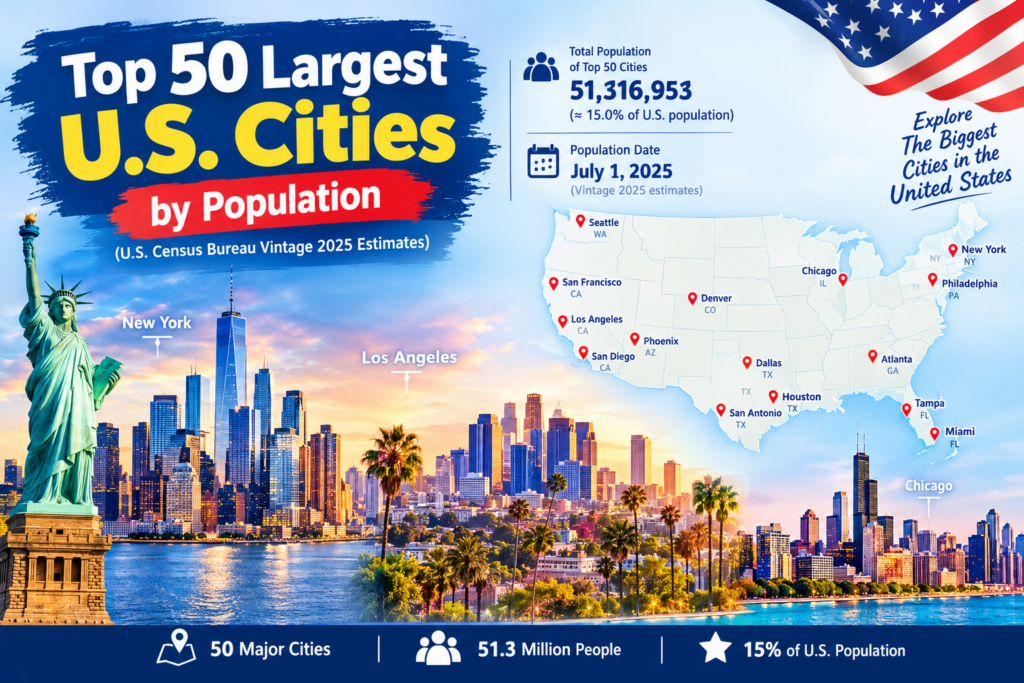

Last verified: October 12, 2026, using the U.S. Census Bureau’s Vintage 2025 city population estimates (population as of July 1, 2025).
For international visitors planning a trip around the United States, the country’s largest cities can be useful starting points for choosing destinations and comparing travel distances. This ranking lists the 50 largest U.S. cities and city-government geographies by resident population, using the latest completed Census estimate vintage available for this article.
Quick Answer
New York is the largest U.S. city by population, with an estimated 8,584,629 residents on July 1, 2025. Los Angeles and Chicago rank second and third. The table below follows the U.S. Census Bureau’s Vintage 2025 estimates and includes city or consolidated-government geographies, not metropolitan statistical areas.
The 50 entries below have a combined estimated population of 51,316,953—about 15.0% of the U.S. population of 341,784,857 on July 1, 2025. These figures use the same Census Vintage 2025 reference date; the share is rounded to about 15%.
Top 50 Largest U.S. Cities by Population
Population figures are estimates for July 1, 2025. They are not 2026 projections. The “State / District” column includes the District of Columbia where applicable.
| Rank | City / government geography | State / District | Population |
|---|---|---|---|
| 1 | New York | New York (NY) | 8,584,629 |
| 2 | Los Angeles | California (CA) | 3,869,089 |
| 3 | Chicago | Illinois (IL) | 2,731,585 |
| 4 | Houston | Texas (TX) | 2,397,315 |
| 5 | Phoenix | Arizona (AZ) | 1,665,481 |
| 6 | Philadelphia | Pennsylvania (PA) | 1,574,281 |
| 7 | San Antonio | Texas (TX) | 1,548,422 |
| 8 | San Diego | California (CA) | 1,406,106 |
| 9 | Dallas | Texas (TX) | 1,329,491 |
| 10 | Fort Worth | Texas (TX) | 1,028,117 |
| 11 | Jacksonville | Florida (FL) | 1,017,689 |
| 12 | Austin | Texas (TX) | 1,002,632 |
| 13 | San Jose | California (CA) | 989,814 |
| 14 | Charlotte | North Carolina (NC) | 964,784 |
| 15 | Columbus | Ohio (OH) | 938,396 |
| 16 | Indianapolis (balance) | Indiana (IN) | 901,116 |
| 17 | San Francisco | California (CA) | 826,079 |
| 18 | Seattle | Washington (WA) | 784,777 |
| 19 | Denver | Colorado (CO) | 740,613 |
| 20 | Nashville-Davidson (balance) | Tennessee (TN) | 721,074 |
| 21 | Oklahoma City | Oklahoma (OK) | 719,849 |
| 22 | Washington | District of Columbia (DC) | 693,645 |
| 23 | El Paso | Texas (TX) | 683,012 |
| 24 | Las Vegas | Nevada (NV) | 679,817 |
| 25 | Boston | Massachusetts (MA) | 672,973 |
| 26 | Detroit | Michigan (MI) | 649,095 |
| 27 | Louisville/Jefferson County (balance) | Kentucky (KY) | 641,962 |
| 28 | Portland | Oregon (OR) | 635,109 |
| 29 | Memphis | Tennessee (TN) | 609,647 |
| 30 | Baltimore | Maryland (MD) | 569,997 |
| 31 | Milwaukee | Wisconsin (WI) | 562,407 |
| 32 | Albuquerque | New Mexico (NM) | 556,588 |
| 33 | Fresno | California (CA) | 555,549 |
| 34 | Tucson | Arizona (AZ) | 548,371 |
| 35 | Sacramento | California (CA) | 536,449 |
| 36 | Atlanta | Georgia (GA) | 529,110 |
| 37 | Kansas City | Missouri (MO) | 521,220 |
| 38 | Mesa | Arizona (AZ) | 513,656 |
| 39 | Raleigh | North Carolina (NC) | 506,306 |
| 40 | Colorado Springs | Colorado (CO) | 494,743 |
| 41 | Miami | Florida (FL) | 489,812 |
| 42 | Omaha | Nebraska (NE) | 488,797 |
| 43 | Virginia Beach | Virginia (VA) | 453,737 |
| 44 | Long Beach | California (CA) | 450,469 |
| 45 | Oakland | California (CA) | 440,838 |
| 46 | Minneapolis | Minnesota (MN) | 430,324 |
| 47 | Bakersfield | California (CA) | 422,165 |
| 48 | Tulsa | Oklahoma (OK) | 416,209 |
| 49 | Tampa | Florida (FL) | 413,554 |
| 50 | Aurora | Colorado (CO) | 410,053 |
Note on consolidated governments: Indianapolis, Nashville-Davidson and Louisville/Jefferson County are listed as “balance” geographies. A balance is the consolidated city or government area after separately incorporated places within its boundaries are excluded under Census definitions. These figures are therefore not perfectly comparable to every city’s municipal boundaries.
What This Ranking Measures — and What It Does Not
This is a ranking by population within the geographic area represented in the Census table. It is not a ranking of the largest metropolitan areas, built-up urban areas, or cities by land area. City boundaries vary considerably: a city with a large municipal boundary can rank higher than a similarly sized urban center with a smaller incorporated area, even when the surrounding metro areas tell a different story.
A metropolitan statistical area (MSA) covers a broader region built around an urban core and connected counties, using federal statistical definitions. Its population can include many cities and suburbs. For example, the population of the Dallas–Fort Worth metro area is not the same measure as the population of Dallas city or Fort Worth city alone. Use city-proper figures when comparing city boundaries, and MSA figures when comparing metropolitan regions.
Geography also explains why Jacksonville ranks above some cities with larger urban cores: Jacksonville’s consolidated city-county government covers a broad area. Atlanta and Miami have much smaller city boundaries relative to their wider metro regions. The population ranks should not be interpreted as a measure of regional influence, density, or total metro population.
Planning a Visit Across Major U.S. Cities
Population can help identify major destinations, but it does not tell you how far apart they are, how long travel takes, or whether a route is practical. Check flight or rail schedules, local transport, seasonal conditions and accommodation availability before building a multi-city itinerary. If you are visiting the United States from abroad, also keep your travel documents and medical needs in view while planning.
Visitor medical insurance may cover eligible medical expenses during a U.S. trip, subject to the plan’s benefits, limits, exclusions and eligibility rules. Coverage varies by plan, age and pre-existing-condition provisions. Review the policy wording and compare options at OnshoreKare’s U.S. visitor insurance page before choosing a plan.
Frequently Asked Questions
What is the largest city in the United States by population?
New York is the largest, with an estimated population of 8,584,629 as of July 1, 2025, according to the Census Bureau’s Vintage 2025 estimates.
What are the five largest U.S. cities?
The five largest are New York, Los Angeles, Chicago, Houston and Phoenix, based on the Census Bureau’s July 1, 2025 population estimates.
Are city populations the same as metropolitan-area populations?
No. City population refers to the geographic unit listed in the city estimates. A metropolitan statistical area covers a wider region, often including multiple cities and surrounding counties. The two measures should not be mixed.
Why are Indianapolis, Nashville and Louisville marked “balance”?
The Census Bureau uses “balance” for the portion of a consolidated city or government that remains after separately incorporated places within its boundaries are excluded. The figures reflect those defined geographies rather than an ordinary city boundary.
How often do city population rankings change?
The Census Bureau releases new population estimate vintages and may revise estimates for prior years. Ranks can change when populations grow at different rates or estimates are revised. Check the current Census city and town population tables before relying on a ranking for a later year.
Related Resources
- U.S. state abbreviations and map guide
- Parent visitor visa guide
- Visitor insurance for travel to the United States
Official Sources and References
- U.S. Census Bureau — City and Town Population Totals: 2020–2025. The official data page identifies Vintage 2025 as the most recent completed vintage and links the ranked table.
- U.S. Census Bureau — Vintage 2025 city and town population estimates, May 14, 2026. The release lists the 15 most populous cities as of July 1, 2025.
- U.S. Census Bureau — QuickFacts: United States, for the July 1, 2025 population estimate of 341,784,857 for the United States and city-level Vintage 2025 figures.
- U.S. Census Bureau — Population Estimates geography terms and definitions.
Get the Printable Top 50 U.S. Cities List
Take the population ranking with you as you plan a U.S. trip. The printable guide includes all 50 cities, population figures, state or district, and a short planning checklist for building a multi-city itinerary.