
Check the official U.S. Department of State guidance before applying, because visa procedures can change.
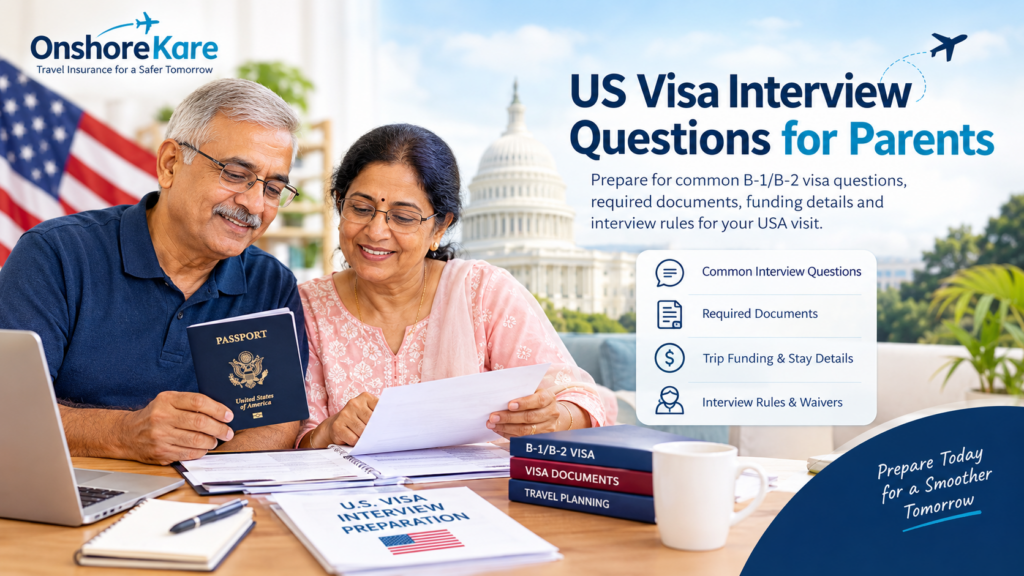
When parents apply for a B-1/B-2 visitor visa to visit their children in the United States, they may be asked about the purpose of the trip, how long they plan to stay, how the visit will be paid for, and their circumstances at home. There is no fixed list of questions, and no prepared answer or document can guarantee approval. The most useful preparation is to understand the trip and answer truthfully. For broader planning, see our guide to a parent visiting the United States.
Quick Answer
Parents applying for a U.S. B-1/B-2 visa should be ready to explain their visit, expected dates, funding, and circumstances at home. Under Section 214(b), applicants must establish eligibility for the temporary visitor category, including that their visit is temporary. Their own circumstances matter; an invitation letter or a U.S. relative’s affidavit of support is not required and is not a deciding factor in visitor-visa issuance. Since October 1, 2025, applicants over age 79 generally need an in-person interview, with limited exceptions for qualifying renewals and other specified categories.
Common U.S. Visa Interview Questions for Parents
These are examples of questions a consular officer may ask. The officer may ask different questions depending on the application and interview. Parents should answer in their own words, using facts that are accurate for their situation.
1. Why do you want to visit the United States?
Explain the actual purpose of the trip, such as visiting a son or daughter, spending time with family, attending a family event, or sightseeing if that is part of the plan.
Example structure: “I plan to visit my [son/daughter] in [city] from approximately 2026 to 2026 for [specific reason]. I intend to return to [home country] after the visit.” Use only details that are true and consistent with the application.
2. How long will you stay?
Give the expected length of the visit and explain the planned dates as clearly as possible. If the dates are flexible, say so honestly. A visa’s validity is not the same as the period of stay authorized after entry; the admission record and U.S. Customs and Border Protection determine the authorized stay.
For more on visa validity and the authorized stay shown on Form I-94, read the B1/B2 stay and I-94 guide.
3. Who will pay for the trip?
Explain whether the parent will pay from personal savings, pension or other income, whether the U.S. host will cover some costs, or whether expenses will be shared. The answer should match the real arrangement. Do not claim that a relative is paying if that has not been agreed.
4. What does your son or daughter do in the United States?
Be prepared to describe the child’s work or study situation and general immigration status accurately, if asked. The parent does not need to memorize a script; they should understand the basic facts of the visit and host.
5. What do you do at home, and what will bring you back?
Explain the relevant circumstances that connect you to your home country. Depending on the person, these may include work, retirement, family responsibilities, property, community commitments, or ongoing plans. There is no single document or “strong tie” that guarantees a visa. The officer considers the overall circumstances.
6. Have you travelled internationally before?
If asked, describe prior travel and whether you complied with the conditions of those visits. A first international trip is not itself proof of ineligibility. Answer the question directly rather than trying to make a travel history sound more extensive than it is.
7. Where will you stay in the United States?
Know the planned address or accommodation arrangements. If staying with family, give the correct address and explain the arrangement. If the itinerary includes hotels or several cities, be familiar with the actual plan.
Documents: What Parents Should Prepare
The Department of State lists the basic visitor-visa application requirements, including a valid passport, DS-160 confirmation, and any required appointment or fee records under the relevant post’s instructions. A consular officer may request additional information. Supporting documents vary by applicant and post, so check the instructions for the embassy or consulate handling the application.
| Topic | What to have ready |
|---|---|
| Application and identity | Valid passport, DS-160 confirmation, appointment confirmation and fee receipt if required by the local process. |
| Purpose and itinerary | A clear explanation of why the parent is travelling, expected dates, planned accommodation and any important family event. |
| Personal finances | Where relevant, evidence of the parent’s own income, pension, savings or available funds that accurately reflects their situation. |
| Home-country circumstances | Relevant information about employment or retirement, family responsibilities, residence, or other circumstances connected to the parent’s return. Bring supporting records if useful and available. |
| U.S. host details | Know the host’s name, address, relationship to the applicant, and relevant details of the visit. Documents from the host may be useful for practical planning but are not required for a visitor visa and are not a substitute for the parent establishing eligibility. |
| Sponsor documents | An invitation letter or Form I-134, Declaration of Financial Support, is not required for a visitor visa and is not a deciding factor in issuance. Do not treat it as an essential document. If a document is provided for context, it should be accurate and should not replace the parent’s own explanation. |
The State Department specifically advises that applicants qualify based on their own ties abroad, not assurances from U.S. family or friends. See the official visitor visa guidance for the current requirements.
Interview Waivers and Applicants Over Age 79
Age alone no longer generally exempts an applicant from an in-person nonimmigrant visa interview. Effective October 1, 2025, applicants under age 14 and over age 79 generally require an in-person interview, subject to specified exceptions.
One relevant exception may apply to a B-1, B-2 or B-1/B-2 renewal submitted within 12 months of the previous visa’s expiration, where the prior visa was issued for full validity and the applicant was at least 18 when it was issued. Applicants must also meet the Department of State’s other criteria, including applying in their country of nationality or usual residence and having no visa refusal unless it was overcome or waived. A consular officer can still require an interview. Check the official interview-waiver update and the specific embassy or consulate’s instructions before booking.
Practical Tips for Older Applicants
- Review the DS-160 and appointment details before the interview so the parent is familiar with the information submitted.
- Keep documents organized, but do not assume that presenting a large folder will guarantee approval.
- Answer the question asked in a clear, natural way. If a question is not understood, ask the officer to repeat or clarify it rather than guessing.
- There is no official standard interview length. Prepare for a concise exchange, but allow time for additional questions.
- Interview language options and interpreter arrangements vary by embassy or consulate. Check the specific post’s website and appointment instructions; do not assume a local-language interview or translator will be available.
- Make sure the application, spoken answers and supporting information are consistent. Never memorize an answer that does not reflect the parent’s actual circumstances.
What If the Visa Is Refused?
A refusal notice should identify the applicable legal section. A refusal under Section 214(b) and a refusal under Section 221(g) have different implications and next steps. Read this guide to 214(b) and 221(g) refusals to understand the distinction. Follow the instructions on the refusal notice and the Department of State’s official visa-denial guidance; do not assume that the same response is appropriate for every case.
Applicants from a country currently subject to the U.S. visa bond programme should also check the State Department’s current list. The bond requirement is not universal and is determined through the official process. See OnshoreKare’s U.S. visa bond guide and verify the current list on the Department of State’s official countries subject to visa bonds page.
Planning for Your Parents’ Health During the Visit
Visitor medical insurance is not a general federal requirement for B-1/B-2 visa issuance. However, healthcare in the United States can be expensive, and a suitable visitor insurance plan can cover eligible medical expenses when the circumstances meet the policy terms. Benefits, age-related maximums, deductibles, exclusions and pre-existing-condition provisions vary by plan. Review the policy wording before purchase rather than assuming every illness or existing condition is covered.
Compare visitor insurance options for the United States, review options for visitors over age 70 and visitors over age 80, and read the guide to travel insurance for pre-existing conditions. Check each plan’s age eligibility and policy maximum for the parent’s age, along with the exact benefits and exclusions that apply.
How the Main Concepts Connect
A parent’s visitor-visa preparation has several connected parts: the B-1/B-2 category defines the permitted temporary visit; Section 214(b) concerns whether the applicant establishes eligibility; the interview-waiver rules determine whether an in-person interview is generally required; and the parent’s own circumstances and truthful answers are central to the application. After travel is approved, the family can separately plan the visit and compare visitor medical insurance based on age, health history, benefits and exclusions.
Frequently Asked Questions
What are common B-1/B-2 visa interview questions for parents?
Questions may cover the purpose and duration of the trip, who will pay, where the parent will stay, what the U.S. host does, and the parent’s circumstances at home. The exact questions vary, so answers should be truthful and specific to the applicant.
Does a U.S. child need to provide an invitation letter or Form I-134 Declaration of Financial Support?
No. The Department of State says an invitation letter or declaration of financial support is not required for a visitor visa and is not a deciding factor in issuance. Applicants must establish eligibility based on their own circumstances and ties abroad.
Do applicants over age 79 need an in-person interview?
Generally, yes, under the rules effective October 1, 2025, subject to specified exceptions. Some qualifying B-visa renewals may be eligible for an interview waiver, but applicants must meet all applicable criteria and a consular officer may still require an interview.
Can parents request an interview in their preferred language?
Language options and interpreter arrangements vary by embassy or consulate. Check the specific post’s official website and appointment instructions before scheduling.
Does visitor medical insurance guarantee that all medical bills will be paid?
No. A plan may cover eligible expenses subject to its benefits, limits, deductible, exclusions, age provisions and pre-existing-condition terms. Read the policy documents before purchasing.
Official Sources and References
- U.S. Department of State — Visitor Visa
- U.S. Department of State — Interview Waiver Update, September 18, 2025
- U.S. Department of State — Visa Denials
- U.S. Department of State — Countries Subject to Visa Bonds
Get the Parents’ U.S. Visit & Visa Preparation Checklist
Use this printable checklist to organize the visa application details, prepare for common interview topics, and plan the visit. It is a preparation aid, not legal advice and not a guarantee of visa approval.